Pod Tiki: 'ti Punch

A small wooden dock; ropes encircling the pilings, nets draped like cobwebs over tin lean-tos, and a turquoise crystal sheet of Caribbean Sea stretched towards the horizon. The masts of small sailing vessels divide the sky like tall Georgia pines. Long commercial fishing rods hang over the gunwales of charter yachts, bending on the early morning breeze like the lazy palm fronds lining the shore. Behind the dock a backdrop of a modest port town. A La Belle Creole’s arches lead down the rue where colonial era buildings house Parisian cafes and no judgement served to those who fancy a mid-morning digestif. 

That was the Martinique in Bogart’s To Have And Have Not. The film bares little resemblance to the famous Hemingway novel and I assume less to the modern port of Fort-de-France, but that scene makes up part of my tropical fantasy. We all have it, a place in our minds that nowhere on Earth, no matter how picturesque it may be, ever quite checks all the boxes of what we were expecting. That’s because what we’re expecting doesn’t exist, and that’s ok. That’s the essence of Tiki. 

But every once in a while, like that perfect pairing of flavors, we find it. It happens when we have that fortuitous balance of opportunity and happenstance. We get a glimpse of our personal island. It’s those glimpses that keep folks like me wandering in excitement for what may be the next piece of paradise. That’s why I dream of Martinique. 

Way down in the windward islands Martinique shares a big part in the lure and majesty of the Caribbean. It also shares an historical part of the sea with the birthplace of rum, Barbados. Like most of the Caribbean before Columbus the island was inhabited by Arawak and Carib peoples. By the 17th century France had laid it’s claim and solidified itself as a player in the colonial Caribbean. English, Spanish, Dutch, American, African and French cultures spin together like a brush through an artist’s palate. Martinique is one of those places that stands out as a truly balanced cultural cocktail. 

I’ve never been to Martinique, though I very much long to see her. Thus, today I invite you to sail with me on a little journey through my mind’s piece of paradise. Welcome to Pod Tiki. Let’s talk about ‘ti Punch. 


***

The story of ‘ti Punch doesn’t necessarily fall with the drink itself. The drink is not particularly complex or hold a rich historical drama. ‘Ti Punch is rather quite pallid in comparison to our usually multifaceted concoctions, but for the ingredients, tools, and terroir. ‘Ti Punch is about slowing down and enjoying simplicity. Let’s go. 

Along the portrait of rolling fields adorned with local flora that is Habitation Clément are planted the historical seeds that are the root of our tale. This first stop in my mind’s eye takes us to a rattan chair overlooking a lime green field dotted with palm trees. The sun is out but not yet overbearing and the humidity doesn’t bother me in my linen shirt and shorts. The scent in the air is fresh but a bit sweet. Behind me looms the prodigious Clément Estate and beside me a small round table. On that table a bottle of Clément Rhum Agricole.  

Throughout our inebriated odyssey sugar has remained a constant throughline. Regarding cocktailia and the significant rise of the New World. But alas, the mighty tend to fall the hardest. In the late 19th century the boon of Caribbean sugarcane fell victim to larger South American plantations. Easier to fill the hulls of your ships from one port than to make several small landfalls along the Lesser Antilles. Enter Homère Clément. The island of Martinique was suffering a great recession when Monsieur Clément, a prominent mayor on the island, purchased the bedraggled sugar plantation Domaine de l’Acajou, that is now the Habitation Clément. In one of the most prolific instances of rumgenuity Homère decided to pivot production from pure sugar to our favorite most scandalous of spirits. 

Clément didn’t earn his face on mount Lushmore by just making any old Caribbean rum. Much in the way Jamaica added their signature twist to rum Clément was inspired by his previous exposure to French Armagnac distilling. Rather than refining sugar and using the byproduct, molasses, he said poppycock to the precedent. Clément chose to distill his spirit from fresh pressed sugarcane juice extracted straight from the stalks. This devilish deviation resulted in an elegant flavor profile of herbaceous, grassy, tropical earthiness, with underlying notes of fruit. The essence of this new French rhum begot a sense that one was tasting the pleasant terroir of wild Caribbean. With a fresh and prevalent agricultural flavor this new style was dubbed Rhum Agricole. 

Rhum agricole is now made throughout the French Caribbean such as Haiti and Guadalupe, but only rhum from Martinique is governed under the Appellation d’Origine Contrôlée or AOC. Rare in the world of rums to have a governing body the French take their spirits very seriously and the AOC protects the designation of origin for true Martinique Rhums. For his contribution to cocktailia and ultimately this province of Tikidom in which we reside Monsieur Homère Clément gets placed beside the likes of Don Beach, Trader Vic, and Harry Yee as a veritable paragon of paradismal potions. 

Now that the sweet vegetal scent of sugarcane is in the air there’s one more distinctively Martinican ingredient we’re going to need. Sugarcane syrup, or sirop de canne, is unlike simple syrup in such that rather than mixing refined sugar with water, cane syrup is made by boiling down actual sugarcane juice. The result is a viscous amber syrup with the same woodsy, grassy, agricole characteristics as the island’s rhum. 

For the next stop on our pretend peregrination we find ourselves hiking the volcanic tropical forests below Mount Pelée. The air is thick and humid now. A wayward squall has blown over as an ephemeral afternoon storm, stealing the atmosphere and adding to the imposing threat of the infamous volcano. In the damp tropical air we notice an odd shrub taking shelter below the dense tree canopy. Rather than growing randomly the branches of the Quararibea Turbinata tree expel out from a central point on the stem like the spokes of a wheel or blades of a ceiling fan. Early plantation workers found that if they cut just below the wheel of branches on one end and about a foot up on the other to create a handle, then trimmed the radial branches to about an inch, whalah! The perfect tool for mixing. Imagine a stick with a flat spur at one end. Of course we are describing a swizzle stick. This is a thin wooden rod where at one end there are small fingers spreading out in a radius. Initially used for blending soft foods it was only natural for Martinicans to adopt the swizzle stick for the purpose of mixing drinks. Although the Swizzlestick tree grows throughout the Caribbean, Martinicans lay claim to inventing the tool which they traditionally refer to as a bois lélé.  

As the sun begins to recede into the still western Caribbean side of the island we find ourselves at a small portside cafe. With bellies full of French Caribbean delicacies we watch the citrine colors of day ripple on the calm sea from our patio table. It’s still warm but a cool ocean breeze blithely caresses our cheeks. The time has come to combine all we have learned heretofore and finally make a ‘ti punch. 

And make it you will. You see, on Martinique it is custom when one orders a ‘ti punch for the bartender to ask “chacun prépare su propre mort?” Translating to “each prepares his own death.” The drama is a bit inflated, but this is the option of having all the ingredients presented and you prepare your own drink. What sticks out to me about the ‘ti punch is something we haven’t encountered in other recipes. People agree to disagree on how it’s made. It’s unanimous which three ingredients have to and only make up a ‘ti punch, but it’s also totally agreed upon that each individual can manipulate those ingredients any way they like. 

Clear or aged rhum, that is, Blanc or Vieux. Spoonful of cane syrup or a ½ oz? Ice, no ice. In fact, the biggest controversy surrounding ‘ti punch seems to be how to cut the lime. Now that’s refreshing.  

Petite ponch is creole for “little punch”, shortened in island patois to ‘ti punch. Aptly named is this cute mini cordial. Look at that little ‘ti punch, don’t you wanna just go snuggle and squeeze its little limes? But don’t be fooled by its diminutive appearance, this little petite packs a punch. (Get it. Packs a … nevermind.) 

Ah-hem, okay. Drinking trends have ostensibly been steered by the New World since someone eventually told Columbus that Montego Bay wasn’t Hong Kong. Eventually the punch bowl was set aside to make room for coups, flutes, and tumblers. Meanwhile in the Caribbean punch didn’t disappear but went from being a large shared libation to something more resembling the individual cocktails being served in the US. The Caribbean was seeing a tremendous boom in tourism eventually leading to the Daiquiri, Mojito, and Planter’s Punch holding court alongside their Manhattan and Old Fashioned counterparts. But in 1887 we get our first record of ‘ti punch immortalized by one Lafcadio Hearn, a reporter who himself had a penchant for the pungent. The ingredients were relayed as rum, sugar, and lime. What Jeff Berry refers to as the Holy Trinity. 

One of the reasons this drink’s ingredient amounts are so adjustable is because the purpose of the drink itself is so versatile. Sometimes it’s an aperitif, other times a digestif, or as your drink with dinner. From what I understand it’s not uncommon for one to indulge in a little pre-lunch-punch. You know, a little hair-of-conch. 

In any sort ‘ti punch is a very pleasant and flavorful drink that can be enjoyed by rumthusiasts or anyone looking for a tropical taste of Martinique. That is why ‘ti punch has been named the official cocktail of the island. So without further ado, let’s make a drink! 

***

20200428_144858.jpg


Our final stop in my imaginary trip to Martinique finds us at a bar. One of those places where the building facade is open air and we sit inside with the ocean at our backs. French cafe jazz with a calypso flair plays in the distance and the bartender asks, “Chacun prepare su propre mort?” Well, we wouldn’t want to look the fool so let’s go over how to do this. 

We’re going to start with the rhum agricole. I’ve only had Barbancourt and Clément so I can’t speak on other brands. Since Clément is the OG, governed under AOC, and the most commonly found here stateside I use it. I’ve had the opportunity to have Clément Canne Bleue at tiki bars but it’s not easily found in stores. I convinced my local shop to order some but it hasn't arrived yet. It’s top three all-time favorite rums for me. What I am going to recommend using is Clément VSOP. Any shop carrying Clément is likely to stock this variant although I will warn you, it is readily available but one of their top shelfs coming in between $40-$50. I usually don’t condone mixing anything over $40 per bottle, but in this case I feel that getting the smoothest best quality rhum agricole truly brings out the herbaceous nature. I’ve also had Clément Select Barrell which is a fine fine rhum and will bring your cost down to $20. It’s got a little more alcohol burn but the cane syrup negates that almost completely. Using this amber vieux, or aged rhum, gives us a bit softer rounder profile whereas the blanc is grassier. 

Traditional Martinique sirop de canne is not something you can just run to Walmart to pick up. Even online searches didn’t turn up what I was looking for at first. A lot of sugar syrups or even cane sugar syrup turns out to be fancy simple. Remember we want pressed sugar cane syrup, not cane sugar syrup. I really like a brand called “Petite Canne” that I was able to order from kegworks.com. $13 is a small price to pay to be able to recreate that traditional Martinique flavor. 

Then we come to that lime debacle. Having not been to the island yet I can only go on the recounts of others found in my research. It seems the “traditional'' way of adding lime was to cut a circular pattern in the peel, making a silver dollar sized lime coin, deep enough to get a thin layer of pulp. The idea here is by squeezing the lime coin over the drink we get a little bit of juice and a lot of the expressed oils from the peel. Dropping it in makes a delightful garnish as well as aroma. 

But, tradition comes in question here as a story relayed in Jeff Berry’s Potions of the Caribbean recollects a relative of Homère Clément himself making the drink by cutting a lime in half and hand squeezing the halved lime over the drink. This version adds more juice than oils, especially after dropping it in. It also makes the drink a bit pulpy, which I don’t care for. 

Berry’s own recipe calls to cut a half of lime in half. Squeeze both quarter lime wedges into the drink, rub one along the rim of the glass and drop it in. Discard the other. 

My conclusion is that it depends on where in the spectrum between punch and cocktail you want your drink to fall. Allow me to elucidate. If you like a sweeter, more punch-like, drink in a rocks glass put:

2 oz Rhum Agricole

½ oz Sugar Cane Syrup

1 half of Lime 

Pour in booze and sugar, hand squeeze the lime half over the glass, and discard spent shell. Now is the fun part. Grab that bois lele. If you don’t have one a bar-spoon will suffice I suppose. Placing the spur end into the glass you want to agitate the drink by moving the handle back and forth in your palms as if trying to start a campfire. To have this the traditional way do no ice, and you really shouldn’t need it with this sweet herbaceous sipper. The lime adds that hint of tropics you expect while the uncanny grassy notes of the rhum and sirop separate this from any other drink. 

At the other end of the spectrum we have more of a sophisticated cocktail. It’s no wonder they call ‘ti punch the Caribbean version, or varibbean, of the Old Fashioned. For this one we do:

2 oz Rhum Agricole

¼ oz Sugar Cane Syrup 

Large Lime Coin

Pour in the rhum and sugar. Express your lime coin over the drink letting some juice fall in and place it to the side. Go ahead and give it a swizzle. Don’t go so fast that you create bubbles. You want the drink to dance like a rolling boil but not break the surface. When you’ve had enough fun doing that drop your lime coin in. For this one I suggest one small ice cube for to cool and slowly dilute the drink. You will notice the pleasant grass and earthiness of the rhum but with a bit more booziness up front. The sugar and lime fade to supporting roles as the agricole takes center stage. 

Using a standard lime wedge instead of cutting the coin also works to mellow out the rhum bite with a little citrus. I go back and forth between these versions, but before we bid farewell to the French Caribbean there is one more recipe we should mention that brings this all full circle back to the man himself. By 1948 Don the Beachcomber had totally tikified ‘ti punch. Let me introduce the Martinique Cocktail. This may get an episode of it’s own one day but it bears such resemblance to its progenitor it cannot go unmentioned. Don has that way of simultaneously amping up and mellowing out the flavor of a rum. This one calls for another of Don’s special mixes, Don’s Honey. It’s simply 2 parts dark honey: 1 part hot water. Mix till honey dissolves and keep it in the fridge. The Martinique cocktail really blew me away and made my fiance who previously did not like rhum agricole suddenly love it. Use the Clément VSOP for this to really express the flavors. In a blender put:

1 ½ oz Rhum Agricole Vieux 

½ oz Lime Juice

½ oz Falernum

¼ oz Don’s Honey

Dash of Angostura Bitters

½ cup crushed Ice

Blend it all till good and pour into a coup or cocktail glass. Don’t clean the blender right away, you’re going to want more than one. 

And here we are back to reality. Sadly, that concludes our fantasy journey to Martinique. I hope this voyage and this drink has given you all a little piece of tropical fantasy. Jimmy Buffett once sang, “If I ever live to be an old man I’m gonna sail down to Martinique, buy me a sweat stained Bogart suit.” Well, when I finally get down there I’ll don my best linen and practice whistling. I hear all you do is put your lips together...and blow. 

This has been Pod Tiki. Thank You. 

I want to give some props to my sources for this episode. Potions of the Caribbean by Jeff Berry. Rhumclementusa.com. Along with my favorite recipe sites, Imbibe.com, Liquor.com and diffordsguide.com. As well as various stories and anecdotes from around the web. Please follow Pod Tiki @pod_tiki and follow myself @rum_poet. Visit shareyourbuzz.com and click the Pod Tiki Archive tab for all past episodes. My name is Tony and most of all thanks for listening. Santé!
Pod Tiki: Mai Tai Revi

Ever since I started Pod Tiki I’ve known that I know nothing. There is so much surrounding this Tiki and cocktail culture. The stories, the lives, history, and spirits. I always knew I would miss a thing or two or have to update certain recipes along the way. I’m no novice palate when it comes to rums, and that’s not boasting I just drink a lot of rum, but the exponential experiences availed to me by doing Pod Tiki have given me opportunity to really hone in on the essence of certain archetypical tipples. In particular the Mai Tai.  

20200406_123423.jpg

We covered the Mai Tai way back in episode 1 of Pod Tiki. After all, it is the quintessential tikiest of drinks. But, since doing that episode I’ve discovered through sampling and researching that although the recipe I gave is delicious, and way more authentic than some of the makeshift knock-offs, there is indeed a way to get closer to Trader Vic’s original. 

If you want to catch up on the full convoluted history of the Mai Tai I urge you to go back and listen to episode 1 or read the accompanying article at podtiki.com in the Pod Tiki Archives tab. For an extremely brief catch up...

Don The Beachcomber created tiki-a genre was born-Trader Vic began his own brand and became Don’s biggest rival-both became famous for inventing some of the most popular drinks in history-the Mai Tai being the most acrimonious-although Don Beach will forever remain the godfather of tiki it is widely accepted today that the recipe we all acknowledge as the classic Mai Tai is Trader Vic’s.  

There, we’re all caught up. 

Besides my amounts of ingredients being a bit skewed the major thing missing from my first Mai Tai recipe was Rhum Agricole. Agricole is a style of rum made from pure sugar cane juice rather than molasses. This gives the rum a unique herbaceous flavor. Think, a spring day. When a crisp grassiness hangs in the air accompanied by the light scent of flowers. The spelling, R-H-U-M, is French as this style of rum comes to us from the French Caribbean islands. Martinique, Haiti, and Guadalupe being the most popular. 

In this revised recipe we use rhum agricole in the Mai Tai replacing the Barbados rum. Don’t get me wrong, Barbadian rums are exquisite, and make a wonderful Mai Tai, but much to the chagrin of my former self they don’t quite match the flavor of Vic’s original. You see, originally Trader Vic made his Mai Tai using a 17 year old Jamaican rum by J.Wray & Nephew. Well, that particular vintage doesn’t exist anymore. But thanks to good ol’ rumgenuity Vic discovered using a combination of funky dark Jamaican rum and herbaceous rhum agricole from Martinique we could get damn close to that original flavor. As an experiment try mixing equal parts of those two rums in a glass by themselves, the musky-grassy-rumminess immediately elicits a Caribbean terroir. 

Another quick addendum is regarding Dry Orange Curacao. I mentioned previously that Peirre Ferrand is the best, and I stand by that. But a $35-40 bottle of curacao unless you’re mixing for a special occasion or to impress is unnecessary. Bols makes a wonderful orange curacao for a reasonable price. They’ve been used in some of our favorite tiki drinks since the 1950’s. Remember not to conflate orange curacao with triple sec, not the same. Curacao is more like an orange liqueur. 

From here the only other thing that changes is arguably the most important, and that’s the ingredient amounts. The Mai Tai is best when it’s a perfectly balanced bit of cocktailia. One flavor shouldn’t protrude more than another. Like a fine cigar or wine the flavors should swim in harmony. My initial mistake was adding too much orgeat. 

Orgeat is an almond syrup that tastes like Amaretto. You’ll find it in liquor stores by the bitters and mixers, or in groceries amid the coffee syrups. Basically what the author of this recipe did was take the ½ oz of simple syrup used in most punch based tiki drinks and split it into ¼ oz simple and ¼ oz Orgeat. I love almond flavor but neglected to realize it’s also a syrup and adding too much doesn’t necessarily bolster the almond flavor. What it does do is turn your Mai Tai into a sugary syrupy abomination. A dishevelled dosage of saccharine sacrifice. 

Okay, that’s all technical mumbo jumbo. Let’s get to making a drink here! 

You got your shaker, you got your fresh squeezed lime juice, you got your Orgeat and you got your booze. We want to use crushed ice for this one, if you don't have a lewis bag and mallet for crushing you can use bagged ice. Just drop it a few times on the ground to break it up best you can. Pour into your shaker:

1 oz Dark Jamaican Rum

1 oz Martinique Rhum Agricole

1 oz Lime Juice

½ oz Orange Curacao

¼ oz Orgeat 

¼ oz Simple Syrup 

Scoop about a cup of ice in there and give it all a good long shake. Keep shaking, keeeeep shaking. Okay, you can stop. Now pour the whole thing, ice and all, into your favorite Tiki mug. If the ice got too melted go ahead and top it off a litte. I prefer to only use garnishes that actually add to the sensory experience. For this we want a few sprigs of mint. Hold them in the palm of your hand and give them a good slap with the tips of your other fingers. This will express the fragrant oils in the leaves. Pay attention the next time you lift a glass up to your mouth to how you begin to inhale a little before taking a sip. With a balanced Mai Tai and mint garnish you’ll get that olfactory tickle of mint before the sensation of cool liquid hits your mouth followed by crisp grassy notes nuanced with rum funk followed by a lingering sweetness. It’s not a drink. It’s an experience worthy of invoking Tahitian gods. It’s also not too shabby on the patio of an apartment in Nashville with my lovely fiance on a spring night. Ah, a Mai Tai and a bad time? Never the twain shall meet. 

 I often alternate between the traditional Trader Vic Mai Tai with Martinique rhum and the similar “everyday” version using Barbados. Real quick, that recipe is just 1 oz Myers’s Rum, 1 oz Mt. Gay rum, ¾ oz orange curacao, ¾ oz lime juice, and ¼ oz Orgeat syrup. It’s a little less sweet and you get more flavor of dark rum and almond instead of herbaceous. 

The great part of my travels through Tiki is that it can be anything. It’s customizable, and even though I try to look for traditional recipes here on Pod Tiki there is always room for what you like. Every drink is a story, so go make your story. Just remember to tell it responsibly. 

You can visit podtiki.com and click the Pod Tiki Archive tab for all episodes and articles. Follow @pod_tiki on Instagram and find me at @rum_poet. And most of all, thanks for listening.

Pod Tiki: Planter's Punch

“We lost good men that day. To both death and desertion. But not to blame them, for that was my greatest folly.” The old captain sat at a large round table bespeckled in amber candlelight shifting his weight to a slow creek from his wooden chair. Weathered by the indomitable sea and corpulent in rum he regaled his guests with tales of adventure. Cuba, Panama, Maracaibo; everyone in the tavern had heard them all growing more hyperbolic with each retelling but grounded in undeniable truth. For some among them had either sailed alongside the captain or having read the salacious pages of Alexandre Exquemelin. 

Swigging at their tin cups of rum mixed with lime, sugar and spice they listened in awe to all the old tales, but tonight it was Cartagena on his mind. The captain went on, “Don’t mistake, the Satisfaction, a fine vessel she was. But the Oxford, the Oxford…” he paused wistfully, “she keeps the bounty of Cartagena in her belly at the bottom of the sea!” Three times he ventured back to recover her cargo, thwarted each time by the vengeance of the Spanish fleet or the vengeance of mother, mother ocean.  Now he found himself with a new charge as lieutenant governor of Jamaica and with no reason but for pride to dream of the prize he captured that day so many years ago. For the old captain lived in peaceful comfort now dining on cured pork belly, the fairer pleasures of the island and, of course, rum. 

“How about another bowl of punch for my audience.”  The captain bellowed to the barkeep.

“What is this fine concoction we imbibe in tonight, my lord?” One of the guests inquired. “These fruits are exquisite though they do little in masking the real fruit of the island, this jamaican rum!” He guffawed.

To which the good captain explained, “You all should know that I have traded the life of privateering for that of a planter’s. Sugar is as good as gold, and a replanted stalk of cane a true buried treasure.”

“So,” another guest exclaimed, “let us raise this Planter’s punch then in honor of our host.” And they all gave an exuberant toast, “to Sir Henry Morgan! To Captain Morgan!”

Ladies and Gentleman, guys and dolls. Of all the rhythms in the Caribbean there is one cadence that not only drives the beat, but the essence, the economy, the fantasia, and historical significance of an entire region. 

  One of sour,  Two of sweet., three of strong, Four of weak. 

Welcome to Pod Tiki. This week we dissect the cocktail from which all Tiki drinks evolved. The promethean Planter’s Punch. 

<**^**>


A pirate and a gentleman. The two not only mutually inclusive but at times indistinguishable.  Especially so to the Tiano and Arawak people indegenious to the lush mountainous island country just south of Cuba. That is, until an Italian explorer commissioned by the Spanish King Ferdinand II and Queen Isabella, “discovered” the eminent island. In time Jamaica would become a fecund agricultural boon, a colonial chess piece, and in the 17th century coastal city of Port Royal a veritable pirate playground. A den of debauchery, a depot of depravity, a domicile of... well, you get the picture. And what common accoutrement of pirate lore fueled these denizens of the deep? (Sorry, I had to squeeze one more in.) Well, if the title and context clues haven’t tipped you off, it’s rum. 

By the time Captain Sir Henry Morgan’s exploits as a buccaneer, I’m sorry, privateer earned him the role as Lieutenant Governor of Jamaica the island was already one of the new world’s leading producers of sugarcane. Decades earlier a mad dash to acquire as much fertile territory in the West Indies as greedy little monarch fingers could clutch gave new meaning to the term “sugar rush”. And when it was discovered in the brilliant very first case of rumgenuity that a byproduct of the sugar refinement process known as molasses could be fermented into a spirit; at that point the rest is quite literally history. 

 If Rock N Roll spawned from the early Blues musicians of the American south then Jamaica is the Elvis Presley of the rum world. Perhaps it’s the native terroir, rich soil, exotic spices, and high-grade ganja wafting in palm frond humidity. Perhaps it’s the proprietary methods of the old world style of pot-still distillation. Or, it could be the addition of extra blackstrap molasses added during maturation that gives Jamaican rum it’s signature “funky” flavor profile unlike any other rum in the world. Think, roasted molasses. Sweet with a hint of char and that bit of something.. you just can’t figure it out… but it’s... funky

Let’s not get ahead of ourselves though. Some say the word punch is a derivation of the small puncheon barrel from which sailors would receive rum rations. But there is a more likely culprit. Whereas hitherto our journey through cocktailia has ensphered American prohibition this tale introduces us to a new antagonist. My friends, I give you the British East India Company. For the sake of brevity we’re not going to get too deep into the Company as it was commonly known in the 17th century but dial in on one particular word; panch, the Hindustani term for five. You see, the English working in India would wind down their hard spent days of colonization, appropriating natural resources, and carving a path to China by mixing up a bowl of what they called Paunch, from five ingredients. Usually tea, water, sugar, lemon, and arrack; a liquor distillate of palm sap. In 1632 we saw the first British use of the term Punch. This would have been made with mulled wine or brandy. We can thank, (or blame depending on your point of view), the East India Company for introducing some of these prolific drinking habits to the colonists who would inhabit the new world. Or was the idea of mixing rum with local fruits and spices forged of regional necessity. Either way by 1655 punch had made its way to the forefront of social drinking culture in the Carribean.

Concoctions of alcohol, water, and sugar known as slings were already popular across Europe, Asia, and the Americas, but what set punch aside was rather than a jigger of this and a dash of that punch was served in large shareable bowls. Punch bowls were given as gifts to monarchs, used in christening new ships, and served as the center of the meeting table for everyone from distinguished gentlemen to the common working class.  Even your garden variety scalawag would splurge on a bowl of Caribbean punch after a good raid.  

From Panama City through the Caribbean and up to Massachusetts as rum was spreading across the new world so was piracy. The sacking of enemy ships on any side made acquisition of the prefered brandy and wines tenuous at best, but there was this new rum climbing the ranks of intemperance. Viewed initially as an alternative to better liquors rum distillers eventually honed in on taming the essence of this wild spirit. No place was this more apparent than among the avarice of the Caribbean. 

Being widely agreed upon as the birthplace of what we think of as modern rum it is not surprising that Barbados holds claim to inventing the famous rhapsodic recipe for their Bajan Punch. From 1694 we have an example of 2 parts rum, 1 parts water, sugar, and lemon juice - sprinkled with cinnamon, clove, nutmeg - and dashed with bitters then being “frisked to effervescence with a stick!” I don’t know about you all but I feel like we need a lot more effervescent frisking in our lives. Indigenious fruits like pineapple and orange often made it in and lime eventually undermined lemon as the standard cocktail citrus. We don’t know who officially distilled the recipe into song, but in this 1 of sour, 2 of sweet, 3 of strong, 4 of weak was born the basis for what we would all come to think of as the tropical drink. 

As colonialism spread, Port Royal sank, revolutions came and went, the golden age of piracy rose and fell and now here we are. You didn’t think we were going to be able to do an episode of Pod Tiki without coming across Prohibition, did you? Initially rum punch fell out of fashion, giving way to Manhattans and Old Fashioneds and the lot. There were a few revival stories like that of the Planter’s Hotel in St. Louis that claim to have invented the eponymous cocktail, but I think it’s invariably obvious where the name originated. A Planter was actually the term given to the owner or head of the sugar plantations and not the enslaved men doing the work.  It’s serves self evident that planter’s punch was aptly named for the version of it being served on and around the plantations of the colonial West Indies. 

20200321_221247.jpg

And it came to pass, as it often does in our journey, that while our predecessors weathered the 18th amendment some took to rediscovering the indulgences of the Caribbean. Which brings us to the Myrtle Hotel, Kingston, JA circa 1920’s where a guest notes the house recipe as pure Jamaican rum, cane syrup, cracked ice with slices of local pineapple and orange for garnish and sometimes topped with a cherry. He also takes note to relay there is no additional cost for the cherry! Which leaves me to ponder - how enticing was the notion of a free cherry! The Myers’s Rum company was the first to capitalize on the name labeling itself The Planter’s Punch Rum and immortalizing Jamaican as the official rum of Planter’s Punch. The rise in popularity of other brands of Jamaican rum like J.Wray & Nephew and Appleton Estate (the oldest commercial distillery on the island), forced Spanish styles like Havana Club and Bacardi to begin offering darker varieties. Pussers, being the old style rum of the British Navy has tried, but no other style boasts the unique flavor of Jamaican rum. Spanning a complex profile ranging from deep musky sweet notes to nuances of rich tropical fruits it’s no wonder Jamaican rum has become the foundation of so many a tropical libation. Including the Planter’s Punch. So, on that note; let’s make a drink! 

<**^**>


The Planter’s Punch is not so much an individual recipe as it is a class of drink. Historically, each plantation, tavern, and hotel would serve up their own version of this tropical tipple. And that’s a trend that carries into our modern day. From cruise ships to all-inclusive resorts right down to the hotel bar at Doctors Cave Beach in Montego Bay where Cool Kenny served my compatriot and I up a little of his makeshift happy hour concoction. Yet, there are some distinctions between Planter’s and some of the other Caribbean punches. 

First is Jamaican rum. Personally, the darker the better when it comes to Jamaican for me. Some tiki experts suggest Appleton Estate Rare Blend, a 12 yr pot stilled rum that will run you about $45. Great rum, and we all know how important good ingredients are, but upwards of 50 bucks a bottle I can’t justify when there are more affordable options that are just as good. For instance, Smith & Cross is very popular among enthusiasts. I’ve had it and it’s delicious but still too light to offer that true Jamaican flavor. There is no other rum I can find stateside that packs the caramel colored funky essence of Jamaican rum like Myers’s Original Dark. There isn’t much known about Myers’s rum and I gather they like it that way. As long as they keep exporting that sweet sweet distilled molasses that’s fine with me. We know the name dates back to the mid 19th century and it comes from a distillery in Kingston, JA. 

From here things get pretty simple. Our simple syrup mix, which I always prefer making at home is a 1:1 mixture of sugar and water brought to a boil and let to simmer briefly and cool. I recommend using raw cane sugar for authenticity and flavor. You will notice a difference in your tiki drinks over the refined granulated stuff. 

We use a lot of fruit in this recipe and I tell you it tastes nothing like Hawaiian Punch from that giant can our mom’s would bring to elementary school birthday parties. Of course you want your fresh lime juice. The recipe calling for pineapple and orange juices makes perfect sense as they would be common in the region. The versatility of punch makes for much clemency in taking liberties with ingredients. Keeping in the spirit of the traditional recipes I ventured to add mango, which is still found locally around the Caribbean. You want unsweetened pineapple juice whenever possible instead of the concentrated Dole stuff. Trader Joe’s carries great not-from-concentrate pineapple and mango juices. A lot of Spanish markets also carry mango nectar. The orange is easy. I have a cheap manual orange juicer that works perfect. It also works for grapefruit, which is another common island fruit that finds itself into one of our recipes. I use red grapefruit.

I suggest using any premade grenadine from your liquor store. It does add a hint of flavor but mostly gives punch its classic reddish hue. Angostura bitters are frequently used among Caribbean potions and essential to a fruity punch to balance out the sweetness. Finally, some ground nutmeg adds a bit of island spice. I didn’t mess around with clove or cinnamon, but if you're feeling extemporaneously experimental knock yourself out.  

As far as tools go we’ll need a shaker and some cubed ice. Glassware for this drink is all over the place. Traditional festive punch glasses look like little clear handled mugs. A rocks glass also works, if you want to be more piratical. Of course, if you’ve got a favorite tiki mug that’s a go-to. I suggest a clear one so as to enjoy the color. Personally, this type of rum punch occupies a place in my mind full of tropical scents, queen palms breathing on the breeze, and lazy tides lapping at velvet sands. Therefore, I reach for a hurricane glass. 

As you may guess attempting to track down an “original” recipe to such a capricious concoction wasn’t easy. After scouring my literature and various trusted sources I narrowed it down to three recipes I feel make the most of this drink. Keep in mind we’re only covering the Planter’s punch, Barbados, Martinique, Haiti, and Guyana are definitely on the list for future episodes. 

We’ll start with the rhyme. 1 of Sour is lime juice. 2 of sweet is simple syrup. 3 of strong - rum. And water is our 4 of weak. This recipe has a surprisingly fruity element despite not using any fruit juice, save lime. The lack of body makes it light and refreshing albeit quite sweet. The dark rum is prevalent. I imagine it would be a welcomed tropical delight for wayward scoundrels, but for our modern palates it’s a bit bland. That’s why I use fruit juice rather than water. Pineapple and mango. Now, mango is a pretty thick, sweet juice. So I cut the sugar in half. I tend to like the flavors of the fruit without blowing the sweetness out of proportion. If you want to follow the rhyme exactly use orange instead of mango. Dump all these in a shaker, shake, and pour the whole thing, ice and all, into your glass. 

½ oz Lime Juice

½ oz Simple Syrup

1 ½ oz Dark Jamaican Rum

1 oz Pineapple Juice

1 oz Mango Juice

3 Dashes Angostura Bitters

Sprinkle of Nutmeg


The next recipe we’re going to cover is the IBA official. I always like to consult the International Bartenders Association when researching these drinks. Though their recipes usually hit all the bullet points they don’t always encompass the originality of the cocktail the way I try to here on Pod Tiki. But this time they hit it out of the park. The IBA turns the desultory flavors of the classic rhyme recipe into what we modern folk would recognize as a punch. Again I tried with both orange and then mango. I also tried halfing both and making a kamikaze. (Can we still say kamikaze?) Anyway, mango is so strong it overpowers the orange so it’s unnecessary. The verdict is that if you’re going for crisp and refreshing, use orange. For more of a thicker fruit punch flavor, the mango. You’ll also notice this recipe calls for lemon juice instead of lime. Quick historical sidebar; in Colonial era Spanish the words for lemon and lime were the same and often interchangeable depending on availability. In this particular cocktail I found using lemon keeps it light and summery. Therefore I suggest lime/mango juices in winter and lemon/orange in summer. This is a great balanced beverage. Not too sweet. The juices really help bring out the underlying fruitiness in the rum. Here it is. (Note: ¼ oz is a tsp.)

20200314_164737.jpg

1½ oz Dark Jamaican Rum

1 oz Pineapple 

1 oz Orange or Mango

½ oz Lemon 

¼ oz Grenadine 

¼ oz Simple Syrup

Shake, pour and then add 2-3 dashes Angostura bitters


This brings us to our final recipe. This is Tony’s Planter’s Punch. Yep, my personal recipe. Honestly, I didn’t break any grounds here. I simply took a few recipes I found along the way and basically combined them with everything I liked so far. Same rules apply as above for orange vs. mango, but I recommend using the orange here as I found mango overpowers the grapefruit. Okay, are we all on the same page here? Sometimes I laugh because I know how ridiculous getting this into fruit juice and rum is. But that’s the essence of tiki! Maintaining that element of serious silliness. Also, since my tolerance hasn’t leveled out from the Zombie episode yet, I will sometimes modify the 3oz of dark rum to 2oz of dark and 1oz of J.Wray&Nephew overproof Jamaican rum. And, oh yeah. I upped the amounts on this to fill out my hurricane glass and really put my head in vacation mode. Let’s do it. 

1 oz Lime Juice

2 oz Simple Syrup

2 oz Pineapple Juice

1 oz Orange Juice

1 oz Grapefruit Juice

¼ oz Grenadine

3 oz Jamaican Rum

3 Dashes Angostura Bitters 

Pinch of Nutmeg 

Shake it all up and pour all into a tall glass. Watch how the effervescence bubbles up and gives it that true punch mouth feel. Parce your ingredients out and make a few at a time or scale up for a large gathering. Either way this fruit boozy balanced libation is sure to please any experienced rum-head or casual poolside lounger. 

But we’re not quite through. We have to address garnish. I’m really trying to get more into garnishes. I’ve always held the belief that while they’re essential for presentation at a bar, if they don’t affect the flavor they’re unnecessary at home. For instance, mint in a mai tai definitely stimulates the olfactory senses adding to the experience, but skewering chunks of fruit and laying them on top of a frozen daiquiri does little but poke me in the eye when I take a drink. For punch I would say garnish is simply garnish for an individual serving; maybe some nutmeg on top, but for a bowl? For a bowl I think presentation is everything. Therefore, whatever fruits you plan on using in your mix I would buy one extra of each, slice them into wheels and float them atop your bowl and go ahead and sprinkle some extra nutmeg as well. I suggest not putting ice in your bowl as over time you’ll end up with a watery mess. There we are, folks.

Now that all you revelous rapscallions have a piratical potion to transport you to the shores of old Jamaica remember to imbibe responsibly. There’s a reason our favorite spirit got the nickname demon-rum. There is a thin line between bucanero and borracho. And for heaven’s sake, stay safe. Make sure to properly clean your cutting boards, knives, and barware after each use along with properly storing your fresh ingredients. Corona is meant to be served with a lime, not a respirator. 

I also want to give credit to my references for this episode: And A Bottle Of Rum, by Wayne Curtis has been a huge resource in all my work. As well as Jeff “Beachbum” Berry’s website. I also used Wikipedia for my historical research and an Epicurious article by Joe Sevier.

Thank you all for listening. My name is Tony, and we’ll see you next time on Pod Tiki. 

Pod Tiki: The Zombie

Midday, sun shining, the side east of Nashville. Two of them lumbering down the street. Sounds of the city, passing cars-laughing tourists. And the two of them, incongruent, dislocated, hunger growing. Emotion; flittering elation, desire, rage, sadness, then the overwhelming numb. Warm breezes weave scents; the pungent perfumes of the living. And the two of them, soulless empty eyes. Two bodies ambling about without agency. Time seems simultaneously to speed up and slow down as the world around them becomes a distant dream. A wonderland of exotica, a realm of inhibition. The two of them going, going...without knowing where or why, a dizzy trance. Occupying an existence somewhere between limitation and manipulation, restraint and insanity. They’re making their transformation, to something...in between. What began as an innocent date to the Tiki bar begot an uncanny metamorphosis. The two wretches in question? Myself and my lovely fiance perambulating through flashes of ourselves like the living dead. The story you’re about to hear is a cautionary tale. Not for the weak of heart or light of disposition. Ladies and gentlemen, guys and dolls today we unearth the Zombie.   


>>>


As with most tiki drinks the myth of the Zombie actually begins in the Caribbean. The etymology of the word Zombie is almost as convoluted as trying to figure out who really invented the Mai Tai. We can trace various versions to West African terms meaning god, fetish, or soul. But the derivation we are most familiar with in these our modern end times would be the Haitian folklore concerning the reanimated dead. Corpse revival, if you will.  (That’s an easter egg for a later episode.)

Another similarity with tiki culture is that most of our understanding of the Zombie stems from exaggerated and sensationalized accounts of indiginous practices, in this case Voodoo. Haiti, a marvelous culture complete with a vivid landscape of revolution and historical misinformation. Like most Caribbean islands forever marred by colonialism Haiti suffered the fate of being “discovered” by ol’ Chris Columbus. Since then, like anything foreign, the practices of native islanders have been twisted to meet the expectations of wide eyed and unfortunately sometimes xenophobic sensibilities of the west. To be completely transparent most of tiki culture is an appropriation of exaggerated concepts. And that’s ok! I believe we should use the mistakes of history as an opportunity to learn about new cultures and have some fun with rum along the way. 

From here we all know the legend. Reanimated corpses brought back to either do the bidding of a master or reunite a lost loved one or in the case of modern sci-fi to feast on those sweet sweet brains. And much like imbibing in too many Zombie cocktails rarely any good comes of it. I imagine when this staple tiki cocktail was created in 1934 the liken was to the soulless fugue wanderer more than the voracious flesh eating monster so depicted today. Although I have been known to devour some pizza delivery after a few too many tiki drinks. 

The tale of the Zombie cocktail is not much different. A potion transforms a person into... something else. Our story reacquaints us once again to our paradismal progenitor Mr. Don Beach. Legend has it Beach whipped up the concoction for a hung-over patron so he could get through a business meeting. The person returned a few days later saying the drink turned him into a Zombie for days. Cool story, bro. But just Because it fits like grass skirts and coconut bras into our Tiki mythos does not make it true. According to Mr. Beach himself the tale is unfortunately apocryphal. 

You see, Don The Beachcomber’s recipes were well conceptualized and practiced works of cocktailia. His recipes so highly guarded that the bottles used to hold his sundry ingredients were labeled in code rather than the original packaging. Don created his own variants of syrups and elixirs, such as “Don’s Mix”, or Don’s Spices #2 and #4, respectively. Therefore, claiming the meticulously measured 8-10 ingredients in the Zombie creation were simply slapped together as a hangover cure is insulting to the rumgenuity of the great Don of the Beach. (I think I just coined “rumgenuity” for the books.) 

Don Beach didn’t just use a base spirit and add mixers. He assiduously combined different rums to create new and unique flavors.  We can never be sure if he invented or just popularized this technique but one thing can be said with utmost certainty, he perfected it. All this to say nothing of his Dr. Frankenstein level experimentation with fruit juices and spices. His recipes resemble a wizards grocery list. So, considering all this how did we ever discover the recipe to a tiki drink that predates the Mai Tai by a decade? That was thanks to Tiki historian Jeff “Beachbum” Berry.  

In 1994, to decipher Beach’s lost recipe Berry ventured out on a quest that would make Dan Brown jealous. After years of chasing ill-fated leads Jeff Berry came across the old notebook of one of Don The Beachcomber’s original bartenders. Several of the recipes discovered preceded the restructured 1940 drink menu. This lending validation that the Zombie recipe found in the notebook, which sat dormant for decades in an old shirt pocket, was most likely the original 1934 recipe. (I’m not gonna say it was a Hawaiian shirt, but it’d sure be cool if it was, man). 

This is why I personally love Tiki culture. It’s escapism. It’s wonderment. It’s an idealistic vision of a paradismal place in our minds eye. Haitian zombie lore and Tahitian gods. The two clash, yet are eerily similar. And much like the ingredients in our titular cocktail the nuances carry on together in quixotic, exotic, majesty.

So with that being said, let’s make a drink! 

And oh my friends, what a drink it is. I’m not exaggerating saying this recipe reads like the inventory of a witches cupboard. Notwithstanding we must remember that most tiki drinks are derivations of the classically simple Planter’s Punch. You all know the cadence by now, 1 of sour 2 of sweet 3 of strong 4 of weak. Bubble bubble toil and trouble. What makes this libation such a work of art is how much trial and error, know how, and down right RUMgenuity went into crafting such a complex concoction. 

You’re going to need some small measuring tools; a cocktail dropper, and a ½ tsp. If you don’t have a dropper a ⅛ tsp should suffice. This is for the anise. The original recipe does call for absinthe, which is a bit more floral and herbaceous, but Jeff Berry and most modern tiki bars substitute for Pernod. Both are French distilled anise based spirits save the difference that decent absinthe will run you upwards of $50 a bottle whereas Pernod lives around the $30 range. If you’re an absinthe drinker go ahead and splurge but for our purposes it’s unnecessary. And I tend to be a cocktail purist otherwise. Next you will need some Falernum, a rum based Barbadian liqueur with hints of clove, ginger, and almond that will surely affect your Barbadian rhythm. (Pause for dad joke.) This you may have to track down. It should be around the Compari, Luxardo, and Vermouth isle. 

Now, here come the rums. (Queue dramatic music.) We start with the tiki staple, Dark Jamaican rum. For that funk we all know and love my go-to is Myer’s Dark. Next is our filler rum, Puerto Rican Gold. I say filler as this ingredient adds more body than flavor. I reach for my old friend Bacardi Gold in this case. If the drink lacks body for your palate try upgrading this to the Bacardi 4yr. And last but certainly not least - 151 Demerara rum. Jeff Berry suggests Lemon Hart 151 Demerara from Guyana, and that’s what I use. I know what you may be thinking, “Whoa, that’s a lot of rum. I’ll just leave the 151 or the gold out.” Alas, I tell thee! The balance of this drink is such that any alteration of ingredients will throw the flavor profile into utter disarray. After all, what did Jeff “Beachbum” Berry so diligently face the perilous turmoils of Tiki for if you just go sloshing any old half-ass abomination into some plastic souvenir cup? Are you a man, or are you a … Zombie? 

Rounding out our list we will need some grenadine, (store bought is fine), fresh lime juice, Angostura bitters, and finally the illustrious Don’s Mix. Don’s Mix is made by combining 2 parts fresh white grapefruit juice and 1 part cinnamon syrup. Red grapefruit is fine too and any old cinnamon syrup used for coffee or cocktails will work. If you want to get fancy and make your own cinnamon syrup it’s water and sugar boiled with cinnamon sticks, knock yourself out. I just add the grapefruit juice to the store bought cinnamon syrup in a little cup and stir.     

Ideally you want a blender handy, but it’s not essential. If you don’t have one use a shaker, otherwise mix the following in your blender. Ahem…


¾ oz Lime Juice

½ oz Falernum

½ oz Don’s Mix

1 tsp Grenadine

2 dashes Angostura Bitters

6 drops Pernod

1½ oz Dark Jamaican Rum

1½ oz Puerto Rican Gold Rum

1 oz 151 Demerara Rum

1 cup crushed ice


Yep, you read that right. Dump all that rum in there and make peace with your loved ones. Then go ahead and blend or shake it up. The ice serves the dual purpose of watering the potion down and when blended adds a frothiness when poured into your favorite vessel for debauchery. I recommend pouring that baby then adding cubed iced. I find that the blended crushed ice is perfect but too much in the glass will change the flavor of the drink too fast. You all know how much of a stickler I am for using proper glassware. The Zombie of course, I believe, should be served in some variation of scary or aggressive face tiki mug. But this cocktail comes in many vessels. The skull glass, the wide collins glass, the hurricane glass, all acceptable methods of debaucherous delivery for this salacious serum. 

But wait, there’s more! I’m not big on garnish unless it appeals to the flavor or olfactory senses, but much like the lure of Zombie culture itself the pageantry of this garnish is worth the price of admission. Check this out, six episodes in and we finally get to light shit on fire! Take one of those spent half lime shells; you know, the ones you have because you ALWAYS use fresh squeezed lime juice; and hollow it out. Stick two toothpicks into the rind in opposite directions so it will sit atop your glass. Fill that lime rind up with the 151 Demerara Rum and set that motha aflame! For added effect shave fresh nutmeg over top and watch it fizzle. The nutmeg also adds some additional baking spice to both scent and flavor. 

There you have it,  the classic 1934 Don the Beachcomber Zombie. 

If you’re thinking that sounds a bit strong you are dead on. (Zombie pun.) That’s what this cocktail is, in your face. Yet the flavors meld intriguingly well, herbaceous, floral, and spicy rich. Believe me I’ve attempted messing with the recipe to make it a bit more palatable; adding passion fruit or rock candy simple, all of which leave the drink syrupy or bland or out of balance. Don Beach perfected this drink and it knows very well what it is and what it’s meant to be. There is a reason why Don himself would serve no more than two of these licentious libations per victi- I mean, customer. Oh Mr. Beach, that voodoo that you do. 

Look, notwithstanding all the reverence it deserves the Zombie is not my favorite Tiki drink. Usually when I plan on having a drink I plan on having two. I prefer to not be hammered after one drink (seriously, it’s like not even fun). As far as flavor profile goes it’s unusual at best, but when made properly this boozy, spicy, tart full bodied beverage suits Tikidom to a tee. No one can dilute the prowess and  dedication it took to create such a complex and delicately balanced bit of cocktailia. The Zombie was the quintessential Tiki drink before Vic ever traded a damn thing. This was the drink that set the standard for not only Tiki cocktails, but the essence of what Tiki culture was and would become. Beginning with name and following through all the way to the fractured conscience and morning apologies this drink makes a promise and does not renege. The temptation, the desire, the anguish, the torment, the pleasure of the pain… the Zombie. 

Pod Tiki: The Old Fashioned

To say cocktail culture in the Americas was shaped by prohibition would be as vast an understatement as it is cliche by this point.  

But, let’s imagine it’s the year of our Lord 1920. You just returned home from a foriegn place where people spoke in funny accents and other worldy dialects. There were strange teas and foods you’ve never tasted, and something else. A sound you’ve never heard. A horrible guttural bombinating mechanical roar. Then the screams. Your feet were soaked through and mud covered your face and blood - blood on your hands - blood-scream-what language is that-the stench-more blood - and you don’t know which one of your comrades now lying lifeless in the muddy trench beside you it belongs to. You hear the order given in French, look to your commanding officer who affirms, and charge en masse through a deluge of gunfire. How can they be shooting so fast? These guns, these guns are like ... machines.  

You’re snapped back into lucidity by a morose man pulling a cart of brewing tools down the street, “Hey! Watch it, kid.” “Su-sorry, sir.” You’re back in your native land, you made it out the other side of the atrocities, you’re safe. But, sometimes the pounding heart and shaky hand need to be quelled. Other people don’t understand, they try, but they weren’t there. They didn’t see-smell-taste the blood. 

You finally arrive at what you think is the place. Those teetotaling bastards, you did what you did with your head held high for them and this is what they resort you to. A man can fight, kill even for your country, but can’t have a drink. But, how bad could it be? After all, you heard Hemingway and Fitzgerald fancy this establishment, if you can call it that. “Well, here it is.” The back alley door off Bedford St. You kock and the door cracks. “Um, is this Chumley’s?” “Hey, buddy. Speak easy around here, capeesh?” 

The small room is a vibrant juxtaposition to the drab despondency outside. There’s a phonograph playing low in the corner and lights so dim you can barely discern glowing faces as you make your way towards a tall oak bar. One man wearing an austere countenance flicks his head upwards at you as to say without words, “what’ll it be?” There’s no menu, no labels on the bottles, but you know instinctively what to ask for. You say,  “Give me one of those old fashioneds.”  

<-> 

20191116_144810.jpg

As leaves fall alongside the temperatures here in Nashville and the patio tiki bars close up for winter the various remnants of a retro speakeasy movement begin to fill with intemperate dionysians seeking refuge from the inclemency. Most of the allure of the speakeasy revival has reduced to an eye-rolling “secret door” wherein the anachronistic esoteric Victorian craft furniture has been worn, torn, and adorned by unforgiving flocks of peacoat laden party-goers. But the tradition of fine craft cocktails in these our modern times is alive and well. Still, of all the cocktails to fall victim to the 18th amendment why is it the Old Fashioned that seems to have ambled out the rubble like a soldier crawling from the shell of blissful youth? 

I contend simplicity is key. The beginning of a craft movement has to begin with a return to classics, and in a post Stranger Things world hell-bent and hard-up for nostalgia what better than a throwback to the bygone days of our forebears? I mean, it’s literally in the name. Beyond all that I believe this cocktail leads the charge in this modern movement because when done correctly, it actually tastes good!

Let’s face it, there’s a lot of bar menus out there replete with libations featuring ingredients that remind us why they fell out of fashion. Little bottles of tonics, tall bottles of french aperitifs, anise and Fernet and Pernod and eye of newt and bitters infused wizard testes. You can keep all of that, I'm looking for something a bit more … old fashioned? To make a traditional delicious Old Fashioned cocktail you don’t need anything that comes in a dropper or tastes like potpourri. And great news, you don’t need to be wearing a tiny vest!

Refreshingly unlike the divisive Beachcomber/Trader Vic feud the enmity towards fruit-crushed-infused-syrupy-over iced abominations of the Old Fashioned seem to be congruent. There are definitely some variations of prep but before we get into that let’s see what’s so old about the Old Fashioned.  

“Cocktail”, as defined by The Balance and Colombian Repository of Hudson, NY in 1806 reads as follows: “a potent concoction of spirits, bitters, water, and sugar.” It’s analogous to the sour, sweet, strong, weak mantra serving as the basis of most tiki drinks. In the before time these “bitter slings” as they were also called, could be served with any of your garden variety whiskey, rums, and gins as well as some of the at the time more exotic tequila or mezcals. (The Mezcal Old Fashioned is well deserving of its own article.) 

Bourbon seems to have entered the picture around 1800 when the recipe of splashing bitters atop a sugar cube, adding a few small pieces of ice, and finishing with a generous pour of American Whiskey was known as the Whiskey Cocktail. This was the basis from which all early Ameri-cocktails would blossom, and therefore eventually became known as, that “old fashioned” cocktail. It took all the way till 1895 for a recipe we may recognize to be published. 

Dissolve a small lump of sugar with a little water in a whiskey glass

Add 2 dashes Angostura bitters

Add 1 small piece of ice

Add 1 piece lemon peel

Add 1 jigger of whiskey

It would appear that swapping the lemon for orange peel is pretty agreed upon and a lot of reputable tippling spots will add a bordeaux cherry. The co-mingling of bright orange zest with thick rich cherry syrup really adds a level to even the grumpiest old whiskey. 

The Old Fashioned was featured heavily as the favorite cocktail of Jon Hamm’s character in the immensely popular AMC television program Madmen. Can we blame that show for the speakeasy boom of the mid 2010’s? Or perhaps the revival of pre-prohibition cocktails was simply the next step in cultural cocktalia evolution, an answer to the sugary neon Red Bull poisoned nectar of the douche we all tried to pass off as cocktails in the 90’s and early 2000s. Thank heaven for hipsters reaching into the flavored Smirnoff abyss and pulling us out of darkness. On that note, let’s make a drink! 

It should go without saying by now if you’ve read or listened to any other episodes of Pod Tiki that no recipe is ever completely agreed upon, but I’ve distilled the Old Fashioned down to two widely popular variants: mixing in a glass or in a beaker. 

Let’s start with beaker, as it’s probably what you’ve seen in your local watering hole. The standard docket is to put a scoop of ice into a beaker, add 2 drops of Angostura bitters, ¼ oz of simple syrup, and 2 oz of your favorite whiskey. Stir with a bar spoon rapidly till the beaker frosts over then strain into a rocks glass. Peel off a piece of orange zest, twist it over the glass to release the essential oils, rub it around the rim of the glass and drop it in. Add 2-3 pieces of ice. Spoon out one Bordeaux cherry and plop that sucker in there too. It’s ok to get a little of the red syrup from the cherry jar in there, but not too much. And that’s that. 

The second method is more traditional. In your rocks glass place one cube of sugar. Soak that thing with 2-3 dashes of Angostura bitters and muddle that into a paste. Add your orange peel and give that a few pushes with the muddler to release those sweet sweet essential oil flavors and get it to play real nice with that sugar/bitters paste. Add your 2-3 ice cubes and pour whiskey over top. Stir in the glass till sugar is dissolved. We’re only trying to dissolve the sugar not melt the ice. The Old Fashioned is designed to mellow out throughout the course of the drink. We want it to start out full flavored and become more nuanced as the ice melts naturally. Add your Bordeaux cherry and serve. 

I’ve seen some bartenders use orange bitters in the paste and even add a bar spoon of soda water to help dissolve the cube into a paste. Some folks leave the cherry out, some muddle the orange and some just twist it over the glass. Honestly, both methods of prep I’ve found to yield similar results. But, despite how fun it is using a bar spoon in a beaker my penchant towards tradition makes in-the-glass mixing my prefered method. Of course, these are all trifling bickers compared to the real star of this cocktail: Whiskey. 

Keeping in mind that rum is my forte I do reside in Nashville, therefore dwelling among the pervasive ardour of unapologetic over-whiskification. Tennessee and Kentucky are total homers for the boozy grain. I’ll go over what I’ve found in my, ahem… research. Recipes will hold varying nomenclature regarding whiskey, and rye. It’s an all bourbon and shine is whiskey but not all whiskey is bourbon or shine scenario. Unlike the rums we’ve discussed which have virtually nil in regards to regulation whiskey in the Americas is highly governed. The blanket statement of whiskey being any spirit distilled from corn, barley, wheat, or rye is where defuse definitions stop abruptly as the whiskey industry is rife with high passionatos. 

The whiskey we know and love for the Old Fashioned would be your garden variety Tennessee Mash, Bourbon, and Rye, respectively. We begin with a bubbling bog-like vat of grain, water, and yeast called mash. This is where those sweet sweet little organisms eat grain and poop out boozy goodness, more or less. In the Sour Mash style of distilling each new batch begins with a “starter” sample from the previous batch. Think Jack Daniels or Dickel. There is a distinct sweetness that finishes on the back roof of the mouth. Rye, being the most intuitively named of all, utilizes a mash made of at least 51% rye. This tends to have a spicy bite. Most popular whiskey brands will have a rye variant. And finally Bourbon, the most finicky, must be distilled with at least 51% corn, be aged at least 2 years in new oak barrels, and most importantly must be made in the good ol’ U.S. of A. No word on why 51% is the paradigmatic number, but one does not simply argue with a Kentuckian, I do declare! 

I generally go for the good old Tennessee sour mash whiskey. Gentlemen Jack form Jack Daniels is my favorite. It’s a good all around house whiskey that rounds off the edges of the Jack Daniels bite. But, in a cocktail things are different. Plain whiskey is almost too smooth for an Old Fashioned. The sweet and bitters tend to over power the spirit. I find cutting back on sugar helps here. 

Rye will push forward in this drink and a lot of connoisseurs swear this is the way it should be made. The bite cuts through a sweet profile and I find an extra dash of bitters fills this version out nicely. Grainy spice hits you on the back of the tongue with a smokiness. 

To say nothing of geographical prejudice Bourbon reigns supreme in the Old Fashioned cocktail. I prefer Buffalo Trace. Good by itself on a rock this brand of Kentucky’s finest shines bright and plays all friendly-like alongside the bitter-sweet-citrus-rich-depth. A caramel sweetness and smooth bourbon texture leads the waltz in this prohibitions most infamous derivation. 

The most important tenet here is to use what you like. Make the drink especially your way. That’s what great about mixing cocktails. It’s like a homemade salad, putting in things you like will greatly increase the odds it will be delicious. Of course, this goes without saying but as always I will say it … please use fresh oranges! Navels are the best for color presentation but some Florida or Mexican oranges from your local Spanish market are just as flavorful. 

So, here’s my recipe. 

In a rocks glass:

2 bar spoons raw sugar cane or ½ oz simple syrup

2 dashes Angostura bitters 

1 thick piece of orange rind/ bend or twist it over the glass to express the oils, wipe it around the rim and drop it in

Muddle all of that together

Add 2 oz Buffalo Trace Bourbon

1 cube of ice

Stir 

Drop in one Bordeaux cherry along with a little of the syrup from the jar, don’t stir


And there you have it, folks. The Old Fashioned cocktail. 

You don’t need to be Ernest Hemingway or Jon Hamm to imbibe. You can enjoy this Old Fashioned in a vintage high back paisley print chair in a speakeasy or an adirondack on a patio or even sitting at your writing desk typing up an article about said drink, just sayin’. It’s also the perfect accompaniment for almost any cigar pairing. It won’t blow your taste buds out for dinner or dessert. Make it with rum or brandy or whatever spirit suits your fancy. To answer our earlier question of why the Old Fashioned has persevered so well is, well, it’s the perfect cocktail. 

Prohibition has been repealed but the world remains a crazy place teaming with extremely interesting people. So have yourself an Old Fashioned and talk to some. Most of all, enjoy life. You deserve it.  


Pod Tiki: Hawaiian Blues

While Don the Beachcomber and Trader Vic were awash in the fecundity of their newfound Tiki culture, capitalizing on faux exotic escapism and mystical prestidigitation, the gods were stirring over Waikiki. There, on a Pacific island, the traditional flavors of Hawaii began co-mingling with the newfound favor for tropical indulgence. Coconuts and pineapples danced with asian spices, Caribbean rums, Russian vodka, and British juniper. While Havana writhed in revolution America’s wealthy elite found a new playground in 1950’s pre-statehood O’ahu. They also found something else, or someone, rather.  With respect to Don and Vic there was another man who could be credited with promulgating the era of Polynesian Pop. Ladies and gentlemen, allow me to introduce Harry Yee. 

The Tiki torch flame of innovation was not lost on the South Pacific islands whose origins this newly described culture was often attributed. Harry Yee’s 30 years at the Hawaiian Village Hotel was spent creating some of the most popular concoctions in tropical cocktalia, the most famous of which is - the Blue Hawaii. 

Diving in to my research of Tiki and tropical drinks I’ve run across the obvious big ones, your Mai Tai, your Zombie, your Daiquiri. Complex, flavorful, rich in both profile and history. Others fall into the fruity “Boat Drinks” category, while others seem too simple to compel an entire article. In fact, that is why I initially chose the Blue Hawaii as our next recipe. I thought it would be an easy palate cleanse before diving into the burdensome and controversial Zombie. Yet, upon a cursory dive I quickly found the story of Harry Yee and the often confused Blue Hawaiian cocktail. Upon mixing up a few of these at the house for my fiance and I, (yeah, that happened since the last article), I also discovered a quaint and delicious unexpected depth in these two drinks.    

"Those days when tourists came in, they said, 'Give me a Hawaiian drink.' We didn't have any Hawaiian drinks. There were no such things as exotic drinks. Or tropical drinks from Hawaii." Harry Yee needed to invent the Hawaiian cocktail. He got a little help from venerable Dutch distillery Bols. You see, Bols wasn’t getting much love their Blue Curacao variant and approached Yee for some of that much needed island intrigue. Yee was no stranger to Tiki ingenuity. After all, he was the first to appropriate Hawaii’s orchid as a garnish. Yee is purported to be the first to use paper umbrellas, a defining staple in tropical drink accoutrement. The man wasn’t afraid to experiment either, see the Tropical Itch cocktail which came with a bamboo back scratcher towering out of a hurricane glass.  

The Blue Hawaii suffered many iterations while Yee attempted to find that perfect balance of tropical easy-to-sip but oomph-packing enough to compete with boozy Tiki drinks; all while visually invoking the spirit of the Hawaiian islands. He did not disappoint. 

The Blue Hawaii’s name didn’t come from the Elvis movie as many would be inclined to believe. Instead it’s said to take its namesake from the titular Leo Robin song composed for Bing Crosby’s 1937 film, Waikiki Wedding. The marrying of Harry Yee’s expertise, local flair, and time honored spirits make this cocktail a bit of a Waikiki wedding itself. 

So, on that note - let’s make a drink!  


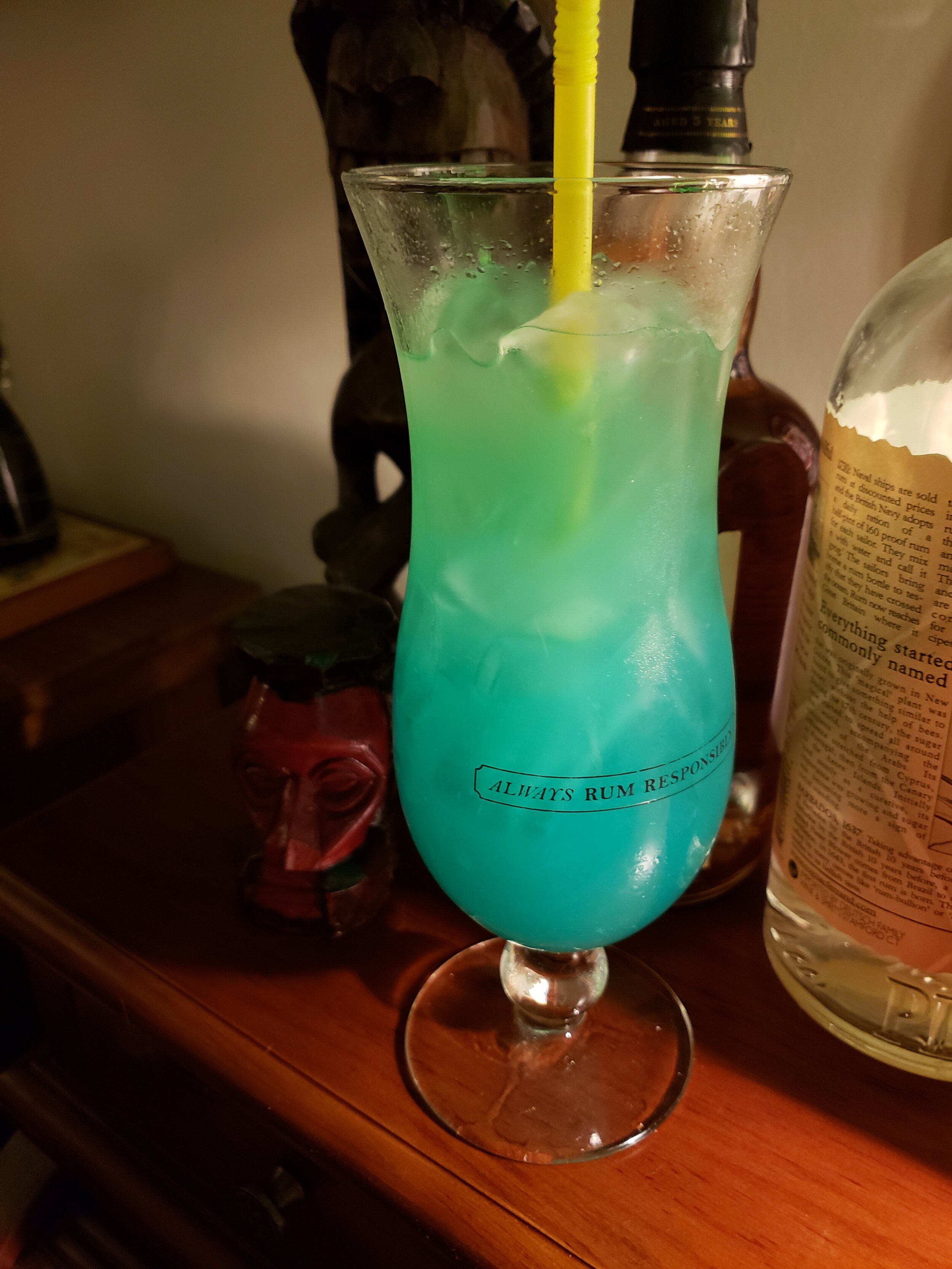
Harry Yee’s original Blue Hawaii recipe calls first for the proper tropical barware. For this we reach for a hurricane glass. If you don’t have one on hand a stemmed beer glass would work or even a pilsner. The idea is we want something tall and clear. No matter how cool your ceramic mermaid tiki mug is (and I know, I have one), to make this drink without being able to admire the seafoam turquoise splendor would be like making love to a beautiful woman with a blindfold on. 

20190826_212552.jpg

Per Harry’s style we’re going to fill that glass with crushed ice and pour in 3 oz fresh pineapple juice. That’s not neon yellow Dole from a can. Grab yourself a pineapple, cut the rind off - making sure you get all those little thorny brown dimples out, and blend it to a liquid. Trader Joe’s sells a not from concentrate unsweetened pineapple juice. Save yourself the chopping and grab that. 

Add 1 oz sweet & sour mix. There are various recipes for making your own mix, and believe how I shutter at the notion of using any kind of pre-mix at all, but since it’s only 1 oz just grab whichever high end organic stuff you can find. Larger liquor stores usually carry decent mixes. I would shy away from grocery store stuff. 

½ oz Blue Curacao. Bols is pretty good and affordable, but not on every shelf. It won’t kill the drink to use the more widely pervasive Dekuyper. 

The mixing of spirits to tease out new flavors is no stranger to tiki drinks, but so far we’ve only encountered the demon rum being implemented. This is the first cocktail in our journey through the barony of belligerence that not only prominently features curacao, usually an accompaniment, but blends vodka with rum. Yee doesn’t specify a brand but I always go for my bottle of Reyka Icelandic vodka. It has a warm small batch craft flavor. Minimal burn with hints of humidity and sweet vegetation, along with a pleasant price tag, makes this the perfect vodka for mixing or highlighting a martini. On the other hand, our Polynesian progenitor does have a preference on rum. Light Puerto Rican. “It’s a better taste.” Says Yee. Hear Yee, Hear Yee! We’re going to use even amounts of 3/4 oz of our spirits.

For reference that’s:

3/4 oz Vodka

3/4 oz Light PR Rum

3 0z Pineapple Juice

1/2 oz Blue Curacao

1 oz Sweet & Sour Mix

Stir gently - like everything is done in Hawaii. Garnish with a pineapple slice and orchid flower. Aloha…  The result is an oceanic blend of sultry south Pacific pacification complicit in dreams of island-pineapple-love-sweet-citrus-sugar-cane-hula-girl in a glass. Rumor has it Yee checked the accuracy of his concoction by holding it up towards the beach. If it matched the color of the Pacific Ocean, it was mixed right. 

Fresh pineapple truly brings out the essence of this cocktail. The sweet & sour has time to shine behind a vodka/rum partnership that’s been bringing wahine's and hoale’s together for decades. Thank you Mr. Yee. 

It sure has been nice to finally cover a cocktail with one distinct agreed upon origin. But alas, you know there has to be a thousand recipe variants because I apparently have chosen a topic of abject opinion to write about. Well, like the saying goes, we all have one of those, right? So, here’s my recipe. 

Ok, we don’t all have access to fresh pineapple all year round. Most of us though can acquire those little cans of Dole. My version keeps with the original but because canned pineapple juice is thicker and sweeter we have to adjust a little. While nothing beats fresh this recipe will still manage to infect your spirit with a little liquid aloha. In a hurricane glass filled with crushed ice pour 2 oz canned Dole pineapple juice, 1 oz of fresh lemon juice (helps cut the sweetness of the pineapple), 1 oz Blue Curacao, ¾ oz Reyka vodka, and ¾ oz Bacardi Superior light PR rum. Stir and drift away. 

To bolster that experience find a nice Hawaiian music playlist or some Exotica by Martin Denny. Fruity cocktails like this pair nicely with a mild to medium bodied cigar. I recommend the KBF by Principle Cigars or whatever your favorite Connecticut wrapper stick. 

Alright so I guess I’ll see ya’ll next ti- , Wait Wait Wait!   What’s that you say? This isn’t the drink you thought you were making? Coconut, you say? Frozen? Well, you have mistaken this original Harry Yee Blue Hawaii for the similarly, very confusingly named, Blue Hawaiian

Tiki culture is no stranger to re-appropriation. In fact, it’s kind of built on it. The Blue Hawaiian cocktail not only borrows its name from the original Harry Yee drink, but its flavor profile from another very famous tropical libation. For the Blue Hawaiian is very much Pina Colada adjacent. There’s not much available in the way of origin story for this drink but it pops up regularly amid the litany of tikidom. Beachbum Berry’s Blue Hawaii subs out the sweet & sour for lemon juice and adds coconut cream essentially transforming it to a Blue Hawaiian. I know, very confusing, but stay with me. I get the impression this is one of those cocktails that evolved naturally over time due to a false necessity. Basically, there’s no need for this drink, but here it is. 

¾ oz Light Puerto Rico rum. ¾ oz Vodka. ¾ oz Blue Curacao. 2 oz fresh pineapple puree. ¾ oz coconut cream, and ½ oz fresh lemon juice. Blend with 1 cup ice and pour into a large cocktail glass or snifter. Again, anything clear enough to admire the color. 

20190816_205611.jpg

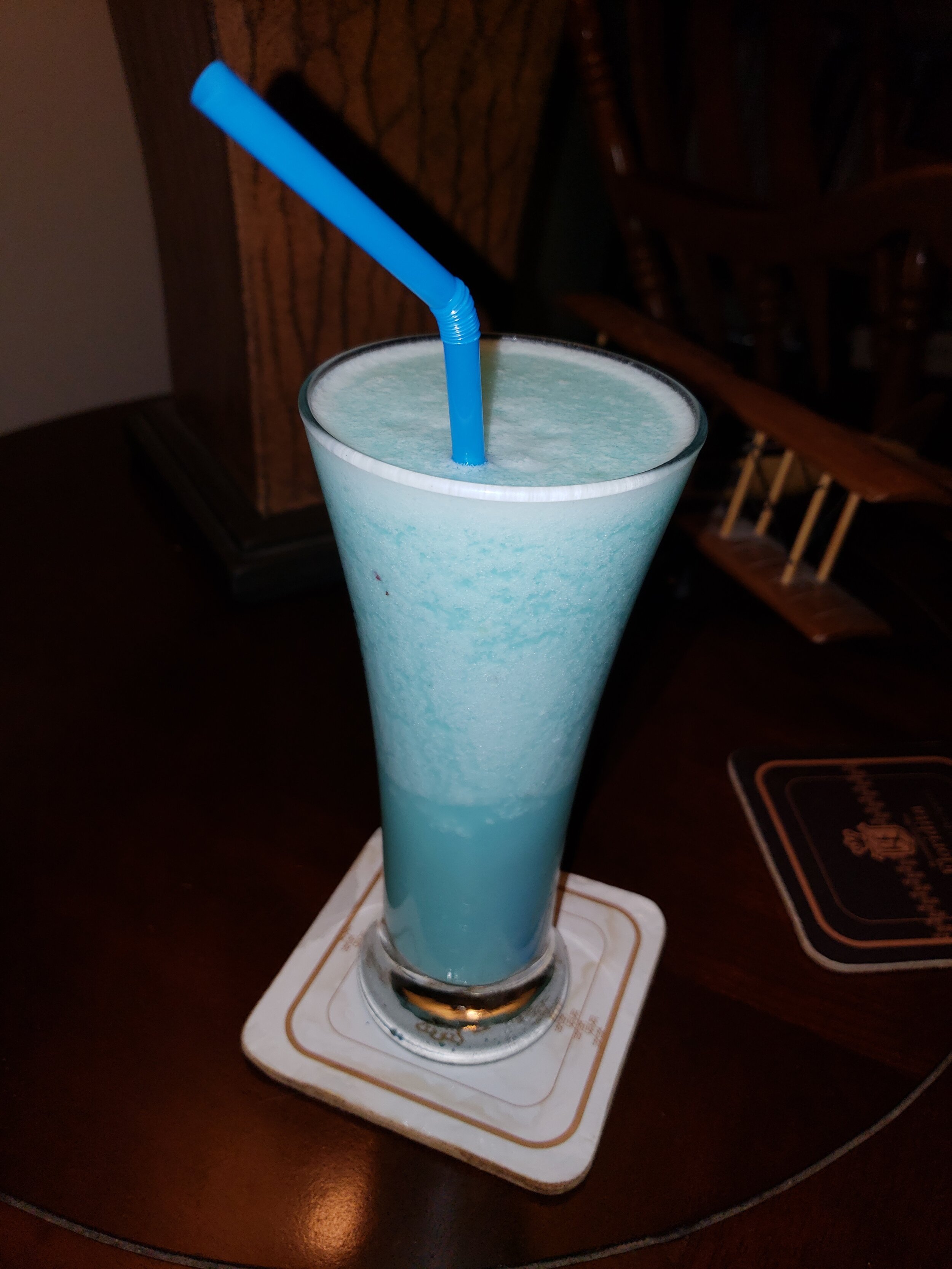
The result is a smooth creamy seaweed colored frozen concoction. The spumescent headiness leaves a dripping froth down the glass with each sip. It’s reminiscent of sea foam washed up by the tide and left on the beach. Pineapple puree combined with the creamy coconut is offset by sour lemon and the bright citrus notes of curacao. Rich and frothy, this cocktail definitely has all the makings of a tropical try hard. Honestly, I’m not a fan. It’s a little too rich and frothy. Too creamy for my liking. 

I prefer my tiki or tropical cocktails a little more fruity and tart or spirit forward. This is for sure a drink created solely for the look and to appeal to as mass an audience as possible. Sure, it’s delicious. Who doesn’t like pineapple and coconut? But there’s little in the way of character or personality within this drink. Although, it fits perfectly within the hands and hearts of pasty overweight tourists rolling around drunk on the lido deck of a cruise ship while their kids shit up the pool. Plus, who wants cream in a tropical drink? “Hmm, it’s a lovely humid day in the Caribbean. You know what would be great right now in this heat? Some heavy cream!” ...Gross. 

Thus, if you’re in the mood for some Hawaiian blues I would sololy recommend the original Harry Yee Blue Hawaii. It’ll add a little tropical tide to your weekend patio escapism without the incapacitating effect of some proofier Tiki drinks. Just remember, as Mr. Yee said, to always “serve with aloha!” 


Pod Tiki: The Daiquiri

“My Daiquiri in El Floridita.” It wasn’t the burly man’s American aplomb that took Constantino aback. Havana had been no stranger to yanquee tourism since prohibition. Some likened La Habana to a Paris of the Caribbean. No, it wasn’t that about the stranger. It wasn’t even his curious Spanish, obviously learned in Spain and not the Caribbean. He walked with a stride betraying an earned confidence bordering on arrogance. Like a grousing old man who pretends to be angry then playfully gives a wink. Constantino, head cantinero at El Floridita, Havana, Cuba circa 1930’s, has the man careening through the front door heading straight for the men’s room. As the relieved looking man strode out and past the bar he became instantly entranced by the flashy bartender holding a bottle aloft and pouring a high long stream of shimmering rum. “What’s that, there?” The man was intrigued. So, Constantino made Ernest Hemingway one of his soon to be legendary Floridita Daiquiris. With an indiscriminate lean towards the bar Hemingway mused, “Not bad. Make me one with no sugar, double rum.” With a contagious nod of approval the Papa Doble was born and the now pervasive Daiquiri caught the intemperate glare of posterity. A glare that continues to see into even these our modern days. This is the story of the Daiquiri.  


Rum, sugar, lime juice. It’s improbable that any one person could really be credited with first combining those three ingredients so prevalent in the age of exploration. It certainly goes back further than Constantino in the 1930’s. British Navy Grog rations had been mixed with lime since the late 18th century, and suspicions connecting citrus and scurvy had been documented as far back as Vasco de Gama. When he found the actual Indies, (take that Columbus.) The Taino people of the West Indies are said to have aided infamous plunderer Sir Francis Drake’s ill crew with an elixir of rum, sugar, mint and lime juice, (see my previous Mojito article.) But alas, for our purposes we are dialing in once again on Cuba. Specifically the small mining town of Daiquiri near Santiago de Cuba somewhere in the late 1890’s and one Jennings Cox.


As to be expected by this point there are multiple origins thrown around regarding this cocktail’s legend, but we’re going to settle in on the one I have prominently found. Jennings Cox was a mining engineer leading a team in Cuba at the behest of President Roosevelt in 1896. A story relayed by Cox’s granddaughter claims that; upon running out of gin while entertaining one evening, and not wanting the serve the primitive rum spirit to his guests straight-up, Jennings Cox combined lime juice, cane sugar and crushed ice. Being thoroughly enjoyed by all, the cocktail was dubbed Daiquiri after the town they were mining. In all likelihood Cox had seen local miners mixing these ingredients into their weekly rations of Bacardi Carte Blanc since his arrival. But, you know what they say about he who writes the history. 


And yes, we’re back at Bacardi. The charcoal filtered oak barrel aged pre-revolutionary spirit of Facundo Bacardi would have looked and tasted much different than the ubiquitous crystalline bachelorette party fuel we find today. Bacardi would have been the prevalent rum in Cuba before the subsequently government owned Havana Club forced the largest family owned distillery in the world off the island. (A title Bacardi still holds as of 2019.) 


Bacardi’s popularity was soaring way before Cox would be exploiting the mines of Daiquiri. At some point the 6 year old King Alfonso XIII of Spain had fallen ill with fever. Because remember for all you aspiring time travelers out there this is a time when people died of diarrhea and a fever. Exhausting all the medical knowledge of the day the king’s keepers began administering the royal child small servings of Bacardi rum till he essentially - passed out. Once again the “medicinal” attributes of rum worked there magic and it came to pass that upon awakening from his healing slumber, (aka alcohol doping a small boy) the callow king’s fever broke and Bacardi was credited with saving the life of His Majesty. 


The Daiquiri had already found its way across the Florida Straits by the early 1930’s when Constantino Ribalaigua Vert pivoted from head bartender to owner of El Floridita. Originally opened in 1817 as La Pina de Plata the famous bar remains perched on the corner of Calles Obispo y Monserrate offering a cool and boozy reprieve to the insufferably hot Caribbean afternoons. Personally, I kinda like the original name. I would totally drink at The Silver Pineapple.     


Today the famous bar inside is decorated in a deep vermillion red, the same color as the bartender’s vintage vests. The sizable murals of a uniformed Fidel have been replaced by mirrors and behind the bar a large stormy sepia portrait of a sailing vessel arriving in Havana harbor looks out over the room. A band plays inside, another Cuban jazz rendition of Boy From Ipanema. And there he is nonchalantly casting aspersions over the bar from his spot in the far left corner. In all his bronzified glory. The lifesize statue of Hemingway. I drank a lot of daiquiris with Hem over the course of my stay in Havana. And true, El Floridita has become a bit of a tourist trap, but the essence of the legendary author looms ethereal as I sat beside that statue sharing his view of the bar that claims the title; La Cuna Del Daiquiri - The Cradle Of The Daiquiri. 


The daiquiri seems pretty straight forward, right?. It’s simple, marrying the very basic of cocktail ingredients. But nary another cocktail, I believe, encompasses as many veritable variations. The cuban Floridita version, the “classic”, myriad slight twists and sidestreet variations to those, and yes - even the frozen-fruit-dad’s cabana shirt on lido deck-boat-drink version has a place in the legendary pantheon of the daiquiri. In fact, this is the first drink we’ve encountered in which I prefer a deviation over either the original cocktail or the Floridita. 


Today we’re going to start with the Jennings Cox recipe, which is accepted as the standard, and two Floridita recipes. There are way too many variations of this cocktail to try and discuss them all. And after the night my girl and I spent consuming a legion of daiquiris attempting to perfect the recipes, I don’t think our livers can handle any more “sampling”. For research purposes only, of course. (He types while currently sipping a research daiquiri.) 


Well, that’s enough banter out of me and we’ve got a lot to cover so - Let’s make a drink! 


When I say we tasted several daiquiris in prep for this article I am not exaggerating in the least. My girl and I exhausted our palates and our sobriety attempting to solidify the best versions of our three daiquiris. As with attempting to codify anything in the world of classic cocktails there are usually 2-3 recipes that claim to be the “original”. That being said, it’s pretty agreed upon that the classic daiquiri cocktail recipe reads as follows: 2 oz light rum, 1 oz fresh lime juice, ½ oz simple syrup. 


This as seen in most bars will be shaken with crushed ice and strained into a coupe. Of course Cuban rum is preferred. Havana Club 3 Anos if you can get it. But, since politics make for strange drinking buddies I have some other suggestions. Defaulting to Bacardi my seem inherent. Eh... Current day Bacardi works great for mojitos and Cuba libres but lacks the necessary depth to stand out in a cocktail that’s as rum forward as the daiquiri. Despite Cox’s desire to make his rum more palatable we have to remember he was serving in a time when rum was still regarded as the plebeian spirit of the third world working class. His contemporaries would have been more accustomed to crisp flowery gin, the wheaty burn of Tennessee sour mash, or French Brandy. We should be accentuating the rum flavor in our daiquiri, not trying to cover it up. For that reason I reach for El Dorado 3yr White Demerara Rum. We’re not going to go into the history of Demerara Rums here but hailing from Guyana, using only sugar cane grown along the Demerara river, and being aged 2 yrs longer than most white rums on the market, El Dorado has been taking this category by storm since they burst on the scene back in 1992. I can’t speak highly enough of this rum and any cocktail calling for a light Puerto Rican rum can be bolstered by using El Dorado 3yr instead.


Pretty simple on this one. Fill a cocktail shaker halfway with crushed ice, pour in the rum, lime juice and simple syrup. Shake vigorously until the shaker feels too cold to hold then strain into a coupe or martini glass. Only notes on this one would be to make sure you use crushed ice in the shaker. It gives the liquid more surface area of ice to bounce off of and aids in dissolving the drink correctly. And of course I don't have to tell you by now you sweet-sweet libation loving fools to always ALWAYS use fresh squeezed lime juice. I recommend making your own simple syrup, too. Get some raw cane sugar and boil up a 1:1 sugar-water mix. In the Pod Tiki household we do one cup of each and keep it in a mason jar in the fridge. Even without the preservatives it should last over a month, but honestly I couldn’t tell you for sure since we usually burn through it post haste. 


Constantino’s El Floridita Daiquiri keeps with the basic ingredients with the addition of Maraschino Liqueur. Also, the way I’ve seen it made there raw cane sugar is used rather than syrup. I generally am not a big fan of syrup if it can be avoided. Unfortunately, in many our tiki drinks it cannot. But alas, here it can. So use the raw sugar. The other defining characteristic of the Cuban daiquiri is that it’s served frozen. 


The blender had recently come into fashion in bars, especially in the tropical prohibition era Havana, and Constantino couldn’t wait to put it into action. He tried many recipes and I believe had four distinct variations on the menu. Even at its inception this contentious cocktail couldn’t be ensconced in just one version. Much like Dirty Dancing 2 Havana Nights, nobody puts daiquiri in a corner. 


After extensive digging through vintage cocktail books and an arduous evening of trial and error, (for research purposes only I implore you to remember), I have settled on the recipe that tastes most like El Floridita Daiquiri I had in Havana. 1 ½ oz El Dorado 3yr Demerara white rum, ¾ oz of lime juice, 1 tsp Luxardo Maraschino liqueur, 1 tsp cane sugar. 


20190728_135746.jpg

Now, the Cubans don’t generally like their drinks as sweet as we do here in the U.S. of A, so if this seems a little dull just replace the cane sugar with 1 tsp of that simple syrup. Place all that in a blender with about 1 cup of ice and go to town. Conventional blenders work fine but as a pro tip from a non-pro, get your hands on a Nutri-Bullet 900. It mixes consistent and the various size mixing cups lend themselves easily to our more Dionysian business. Post pour the drink should melt rapidly eventually resembling a glacier of debaucherous deliciousness floating motionless in an opaque coral colored sea. 


The Maraschino should be present but not in front of the rum. The canvas of this drink should see the flavors swimming in harmony like a well crafted Bob Ross scene. Purportedly upon enjoying seventeen of these delectable deviants in one sitting Hemingway is quoted as saying, “It was moderately terrific and made me feel a friend to all mankind.” Awe, Hem. He liked his double the rum and no sugar. Which leads us to our next version.


The Papa Doble is aptly named after the author who made his home in Cuba and visited El Floridita frequently. Because Hem liked the bitter-sour over sweet Constantino replaced the sugar with grapefruit juice. Born is the Papa Doble Daiquiri. 3oz Light Rum, ¾ oz lime juice, 2 oz grapefruit juice, 1 tsp Luxardo Maraschino liqueur. If you want to get really traditional forgo measuring your lime and grapefruit for simply squeezing 1 half of a lime and 1 half of a grapefruit. That’s how they do it at El Floridita, but as mentioned before, the size of our fruit in the U.S. generally leaves something to be desired. 


This drink is… well, my notes for this recipe just has the word “whoa” written beside it if that tells you anything. And yes, it’s said that Hemingway first encountered the daiquiri because he stopped in El Floridita to use the bathroom. I’m not buying it since his room at the Ambos Mundos Hotel was a mere few blocks away and it’s no secret the man had a penchant for tippling. I’m just saying. This drink packs an expected rum forward kick with crisp but warm citrus notes thanks to the lime and heavy bitter grapefruit pour. It’s actually quite pleasant if you’re the type who has burned out their palate on spicy-bitter-bullfighting-Africa-artillery-cosmic-yee-haw their whole life and needs the equivalent of a pack of lit firecrackers in their mouth just to feel alive. Look, it’s fine, but I have an admission. In Havana my girlfriend actually ordered the Papa Doble while I stuck to Constantino’s original recipe. Which brings us to the final of our main recipes, the Hemingway Special. 


The Hemingway Special is a Papa Doble made so regular people can drink it safely. The prolific writer once bragged in a letter about consuming seventeen! Daiquiris in one sitting stopping only to, “use the can”. By the way, the bathroom at El Floridita seems to play a prominent role in the Hemingway’s mythos. I can proudly say I’ve pissed in the same spot as Hem himself. But seriously, seventeen daiquiris? If these were Papa Dobles that is quite a feat. It also explains why it was said by the end of his life you could see his distended liver through his shirt. It’s said that he would sit in his corner in his white guayabera shirt and blue shorts reading, writing, and entertaining guests sometimes multiple times a day.  *Drink Responsibly and in Moderation.* 


The Henminway Special as it was labeled on El Floridita’s menu back then encompasses the spirit of the old man while maintaining reasonable drinkability. We’re going to use 2 oz light rum, 1⁄2 oz lime juice, ½ oz simple syrup, 1 oz grapefruit juice, 1 tsp Maraschino liqueur. You can blend that with 1 cup ice, or strain and serve. Cocktail glass for frozen, coupe for strained. This version is a perfect meld of tart lime and bitter grapefruit with a hint of the maraschino cherry depth and that sweet rum and sugar. A great cocktail and of the three, my favorite. 


The daiquiri is a perfect example of how splendid simplicity can be. At its core the three ingredients is all you need. Rum, lime, sugar. Even if you’re not into classic craft cocktails, if you’re not that asshole at parties who scoffs at the host’s booze selection or makeshift drink station, (by the way - fuck that guy) or if you’re hosting and want to impress with a simple yet elegant fresh cocktail… the daiquiri is the way to go. Nice and sweet-tart-tipsy. Refreshing refinement that can be teased up and played with to match your flavor profile.  


Ah, but we’re not done. As I mentioned at the top this is a cocktail with many variants and personal play-with-its. And, one of these offshoots is actually my favorite. I have fallen hard for Plantation 3 Star aged silver rum. Plantation does an incontestable job of masterfully blending rums from Jamaica, Barbados, and Trinidad to bring us a superb rum that’s simultaneously full bodied enough for tiki drinks and light enough for beachy cocktails. I could rant on forever about this ambrosia of the Carib and maybe a future series on my favorite brands is in order. As much as I love it, I wouldn’t recommend Plantation 3 for mojitos or cocktails using other heavy flavors, as the Jamiacan in it lends a rich funky character that kinda jumps ahead. But for a rum forward daiquiri it lends itself perfectly to the other flavors. Those of which are Henminway inspired. Here is my personal favorite Daiquiri recipe. 2 oz Plantation 3 Star, ½ oz lime juice, ½ oz grapefruit juice, 1 tsp Maraschino liqueur, 1 tsp simple syrup. Shake with crushed ice and strain into a short coupe. Bam!  


I would also like to give an honorable mention to what I call the Jamaiquiri. Sub out the light rum for Myers or another dark Jamaican rum. Even still, don’t be afraid of the dreaded fruit daiquiri. With fresh fruit and good rum they can be quite pleasant, after all. Maybe we’ll tackle that in our “boat drink” series. But hey, the original is pretty damn good by its lonesome with nary a twist or tweek into cocktail nerddom. There’s the Daiquiri my friends. A classic - nay! - a legend all the way. Salute!

Pod Tiki: The Mojito

A quaint Cuban cafe, Old’s Havana, on Calle Ocho. Beyond an open facade the white noise of an early evening squall slaps at the sidewalks of Little Havana, Miami. Four squat and dark haired middle aged men sardined in the corner play some Latin Jazz. Warble-crooning and easy-plucking at the vinyl strings. Behind the bar a tall young man sporting a white button-down lines collins glasses up about ten across. In each glass he methodically, and with flippant precision, javelines in mint sprigs, then handily into each one scoops two bar spoons of sugar… and waited.


The orders came in legion. Two of them were ours. I watched the bartender brandish a large wooden muddler. Squoosh-splish...The sound of fresh lime juice pressing vigorously into mint and sugar rivaled the tropical shower outside. Each glass got its cummupense. Pour the white rum, a brand I didn’t recognize, into a sugar frothed pallid green slush. Filled with ice every promethean cocktail received a sugar cane stalk and was topped off with sparkling water. I poked my straw deep into the mint and remnants of undissolved sugar. My daughter lifted her glass for a cheers and we each took that metanoial sip. That began in earnest my foray, nay, my expedition into the mojito. 


***


My “research” has since taken me to a plethora of bars and restaurants to find a comparable mojito. Including Havana, Cuba, the birthplace of this convivial cocktail. But we’re getting a bit ahead of ourselves. To me anyway, the story of the mojito is the story of Cuban rum. 


It was the year of our Lord 1862 in Santiago de Cuba when an immigrant of Spanish/French decent opened his distillery. Don Fecundo Bacardi set out to create the best new rum in the Caribbean. His charcoal filtration technique lead to the clear clean style of distilling now referred to as the Cuban style. Its fruity-earthy-crisp-tobacco’ish profile incontestably marries flavors of the Cuban terroir with the smooth easy drinking sensibilities of the burgeoning American tourist boom. (We’ll get there.) The idolic tower distillery in Havana still bears an iconic fruit bat effigy aloft its mighty spire. The impending revolution and Bacardi’s strong political leanings forced him, and consequently his rum, to abandon his native island for less turbulent seas. But not before lending itself to the creation of some of the world’s most popular cocktails. 


Today Havana Club dominates the mojito, but at it’s very root the progenatorial rum would’ve been Bacardi. We’ll compare the two later for our purposes. 


Of course like every single cocktail I’ve researched thus far there is an origin, and an origin. The way back claims the infamous pirate Sir Francis Drake may have initially combined the ingredients we know as the Mojito today as a remedy. Legend has it while somewhere off the coast of Cuba around 1586 Drake’s men found themselves too ill to sail. After consulting the local Taino people the primaveral plunderer concocted a remedy for his sailors consisting of mint - to soothe the tummy, lime - to prevent scurvy, sugar - for flavor, and chuchuhuasi tree bark soaked in rum - said to have certain, ahem - “medicinal” properties. This was what some claim to be the world’s very first cocktail, named after the Spanish moniker for Francis Drake, El Draque - The Dragon. 


Centuries later came the Americans. Yes, we find ourselves back at prohibition. You may be surprised to learn that the ratification of the eighteenth amendment didn’t suddenly turn the whole of the United States into repentant teetotaling puritans. Rather, it was more like the entire country was made to sign a nationwide “prom promise” while millions of fingers crossed behind backs from sea to shining sea. Thirsty American tourists flocked like a murder of booze-mad crows from the eastern seaboard of Estados Unidos to Havana, Cuba. 


The infatuation with our rum-soaked cigar-smoked offshore neighbor didn’t burn out post prohibition. An influx of tourist and mob money made Havana light up like a floating Vegas. Dirty money never sparkled and glistened so bright. Sinatra sang, Hemingway wrote, Ava Gardner rubbed elbows with Nat King Cole and Eartha Kitt while in 1946 the Hotel Nacional hosted one of the largest known gatherings of crime bosses in mob history. 


Amid the glamourous uproar local people still needed normal folk stuff, like a bodega to eat and pick up sundries. In 1942 Angel Martinez opened a little place on the middle of Calle Empedrado in Habana Vieja. Serving dinner and drinks throughout the late 40’s Casa Martinez grew as a hotbed of burgeoning hipster culture. Poets, writers, musicians, and yes - even a few pre-revolutionaries with names like Castro and Guevara came to hang out at the little bar in the middle. Or as it was christened in 1950 - La Bodeguita Del Medio


Bodeguita holds popular claim to inventing the Mojito. Barely a one room wooden barroom, walls covered twice over with handwritten signatures from decades of patrons. Tourists hover around the bar while locals popping by for a quick mojito on their way home spill out of the open facade onto la calle. An all too seasoned bartender with buzzed peppered hair barely cracks a stoic smile at my girlfriend as they mock-dance with the bar between them; arms steepled over rows of small collins glasses. We named him the Cuban Papa. 


The mojito at Bodeguita is pale green and might taste a bit flat to someone used to soda water. In Havana they use sparkling water instead of soda. Yes, there is a difference. Soda water or seltzer is artificially carbonated. The bubbles are larger and more abundant. Whereas sparkling water’s bubbles are naturally occurring from the natural spring where the water is collected. Simply put, smaller softer bubbles. I prefer sparkling water over club soda in my mojitos. Another difference one might find in a Cuban mojito is the mint springs. A strain known as Yerba Buena, they’re way bigger and more verdant than any of the lame limp mint twiglets found in my local Kroger. Keep in mind that pretty much everything in Cuba is grown in Cuba. The mint and lime juice are both farm to table, or farm to glass in this case. 


In Bodeguita the glasses are lined in a similar way as described earlier along the small bartop. El Cuban Papa, wielding a muddler the size of a small baton, preps and attacks the mint-sugar-lime in each consecutive glass with a fervor that sends drops of sugary citrus raining down upon the bar. He eyeballs a decent helping of Havana Club 3 anos, fills the glass with ice and tops off with local bubbly water. The result is a perfectly balanced masterpiece of cocktailia. Not too sweet, prevalent mint, hints of citrus accentuated by the bodily light aged rum. It’s refreshing and easy to go down, (especially at the bargain price of $5 a drink). The rum palate holds its own against any hipster-old-fashioned-pinky-out-thumb-up-your-ass bourbon classist. And, this is the basis for the way I make mojitos. 


Okay, let’s make a drink. I find this recipe works best in a 10-12 oz collins glass. Grab yourself a wooden muddler, bar spoon, and small cubed ice. We’ll need fresh lime juice. Cuban barkeeps will say half a lime to equal ¾ oz. Since the lime selection in the U.S. can vary from hormone induced monolithic green giants to something more like a little green testicle, it’s a safe bet to simply juice your limes ahead of time to assure proper portion control. For the best mint I would look for the live herbs some of your better groceries are carrying now. They come as a little plant ready to be cut right from the source. The other option is to befriend a local bar manager who will get you some of the nice fresh mint from a restaurant supply store. I’m no drink snob, but soggy broken prepackaged mini mint won’t render the flavor we’re looking for in a mojito. My preference on sparkling water is Pellegrino. I find Topo Chico and Perrier too carbonated. Now just grab yourself a bag of raw cane sugar, usually found in the baking aisle, and we’re good to go! 


Oh, dear heavens. Lest I’ve forgotten the most important part. Rum! If you can get your hands on some Havana Club 3 Anos that’s the obvious choice. This drink was invented with Cuban rum and nothing else is quite like it. The 3 year is a pallid off-white color due to the aging in oak barrels and offers a fruity tepid-sweet taste with notes of creamy oak and soft humidity. For something a little sweeter a light Demerara rum fills this drink out nicely. The added earthy/fruity notes are not quite like a Cuban in flavor but they add a complexity that offers a similar body and feel. I use El Dorado if I’m going that route. Cruzan makes a decent cost efficient light rum and Plantation 3 Star will add a hint of funk. I personally am a mojito purest, so I go with Bacardi. It might not be from Cuba anymore, and hard core rum snobs will battle me on this, but a good Puerto Rican rum is not that different from the Cuban. Especially when it’s from the company that invented Cuban rum. I’ve taken my stand and I’ll die on this hill alone if necessary. Fruity and sweet with a little woody spice Bacardi light rum is perfect for mojitos. 


(Sidenote: Havana Club PR light rum is available in the US and supposed to be a comparable replacement for Cuban rum, designed for Cuban cocktails. I haven’t tried it but I have noticed the more pallid tinted color, so maybe there’s complexity there worth a taste.)


Here we go! Fold a good size mint sprig into a collins glass. I go for three tiers of leaves. About 10 leaves. There’s a lot of flavor in the entire sprig so don’t go picking the leaves off and discarding all that minty goodness in the stem.


Add 2 bar spoons of raw cane sugar and ¾ oz lime juice. Now it’s time to muddle. Wait wait wait… Slow down, tiger. Veteran bartenders make it look sexy with all the pomp and circumstance but all we’re really trying to do is bruise the mint to release the flavor and pull the lime and sugar off the proverbial wall of the high school dance and get them all friendly. Too much muddling could result in shredding and you’ll end up with a mouthful of the tiniest salad. 


Eyeball in about an ounce of sparkling water. We just want enough to dissolve the sugar by quickly stirring with the bar spoon. Pour in 1½ oz of rum, no need to re-stir. Fill to the very top with cubed ice and top off to the rim with more sparkling water. Garnish with a fresh mint sprig, giving it a few slaps in the palm of your hand to release the aroma. This is one cocktail that’s acceptable to drink with a straw. For one, for the nature of there being leafs essentially floating around in it, and two, you want to drink this cocktail from the bottom; the province of all that sugar and mint. 


Now, there seems to be some controversy on whether or not the recipe stops here. Recently in Havana and amid the craft cocktail resurgence stateside some establishments have begun adding a dash of Angostura bittesr atop the finished mojito. Honestly, I like it both ways. In fact I will usually have two a sitting and make one each way. The bitters fall slowly through the drink giving a duality to the profile like one of those two-scents-in-one layered candles. 


Mojitos in Havana are the OG. You can count on a more mild yet rum forward experience. Humid and tropical like the place and people of Cuba. In Miami you’ll find just as good of mojitos albeit catering more towards the sweeter more limey taste. Down in Key West there’s a stand selling street side mojitos that are more like rum on ice with a lime twist. (Couldn’t even finish mine.) Here in Nashville we are not wanting for upscale bars. A few of the best I’ve had in town come from Flamingos and Earnest Bar and Hideaway, with a tip of the hat to my boy Matt at Primings who made me a pretty damn good mojito while I sat in the lounge being antisocial doing the research for this article. 


This herbaceous mint tart citrus sweet cane libation is probably my favorite cocktail of all time. It’s perfect with any flavor cigar. You can substitute pineapple or coconut rum if so inclined. It’s a great drink to experiment and even better as the original. Sugar and mint could be adjusted to taste. It’s simple and refreshing, perfect for poolside chilling or late night salsa dancing. Muddle muddle splash pour fizz, the Mojito.


There’s a sign hanging in Bodeguita Del Medio, supposedly signed by Earnest Hemingway, which reads - “My mojito in La Bodeguita, My daiquiri in El Floridita.” There’s some suspect around this being authentic. Some claim the man didn’t even like mojitos! I find it hard to believe Hemingway, who loved Cuba and its people and culture so much, didn’t stop in to the little bar in the middle of calle Empedrado on his way back to his room at the Ambos Mundos hotel for a quick tipple. 


There is one quote Hemingway did say for sure, “If you want to know a cities culture, spend a night in it’s bars.”

Pod Tiki: The Mai Tai

Tiki is not a thatched hut bar at the beach. It’s not cheap wicker citronella torches lining your neighbor's backyard barbeque. And it’s certainly not hipsters in floral button downs drinking a pineapple infused craft beer. No, Tiki is scary. The tiki bar is deep jungle samba, cool trade winds caressing fan palms. It’s droll gnarly totems and thanks to the genius of Don Beach it’s curious elixirs whose true origins and recipes remain disputed to this day.  

Tiki, in Maori legend, was the first man. Adam. Along with his lady Morikoriko, who seduced him after he found her in a pond, they had a baby girl who created the clouds and.... Look, creation myths are convoluted by nature. Let’s just skip ahead a few millennia to the 1930’s when a man styling himself Don Beach opened the first genre defining Tiki Bar - Don The Beachcomber in California. The refractory period between world wars gave rise to an influx of Polynesian Pop Hollywood films while young soldiers returned stateside with stories of far off tropical paradises, and quite possibly the most telling catalyst for tiki fever … a seething post prohibition rum habit. Don used his travels through Polynesia and a not so minute bit of ingenuity to invent the Tiki Bar as we know it.  

  Tiki swept the nation and eventually the world. Then, like a lot of hot-fast cultural fads Tiki simmered and fizzled into an old timey cliche. Until recently. The modern boom-boom! in retroism and classic cocktails has seen an unyielding rise in neo-escapism Dionysian debaucherous class. Where kitsch is cool and sweet molasses is preferred over the wincing burn of Kentucky’s finest there you will find dim lighting, transcendent music, prodigious palms, rattan furniture and the most recognizable of all tiki bar culture, the tiki mug. And in that mug you will find that the most quintessential of all tiki drinks. The Adam. The Mai Tai. 

My own foray into rum began with a homemade concoction of light rum, pineapple juice, and lime. So when I discovered the Mai Tai early into my exploration of vacation cocktails I was instantly hooked. So adorn those floral button-downs and flip-flops, put on your drinking cap and stock your rum cabinet ‘cuz the Mai Tai ain’t no tropical frou-frou drink.  

It was around 1933 that Don Beach mixed a funky dark Jamaican rum and a light Cuban rum with lime juice, bitters, pernod, grapefruit juice, falernum, and cointreau laying ancestral claim to the cocktail’s origin. But another totem on the proverbial Tiki pole says otherwise. Victor Bergeron, better known by his famous monaker, Trader Vic, takes umbrage with this alleged tale of the tai. Vic contends it was a decade later in 1944 at his bar in Oakland that he took a bottle of 17yr old Jamiacan rum off the shelf to pour for some friends. Inspired to compliment the flavor of the rum Vic added some lime juice, a bit of curacao, a dash of rock candy syrup and the one ingredient that separates a true Mai Tai from some bastardized boat drink - Orgeat Syrup. Legend has it Vic served the libation up to his friends visiting from Tahiti who exclaimed. “Mai tai roa ae!”. Tahitian for “the best”.  

Whichever version you choose to believe there is no disputing that the Mai Tai we know and love today is derivative of the Trader Vic Recipe while borrowing heavily from Don The Beachcomber’s penchant for creating a medley of rum flavors in a single cocktail. For our purposes we’re going to shake together the two progenitorial recipes and stir in some widely accepted evolutionary standards. 

*** 

Demon rum. That most scandalous of colonial era, pirate inducing, history-shaping, tiki drink base spirit. We’re going to start with a Jamiacan rum, since both precursory recipes use it. Now there are a lot of variations in rums of this region but most Jamaican rums have a defining characteristic taste profile. I’ve heard it described as the Jamaican rum funk, and that’s really the best way I can relay it. It’s the ambient scent and flavor of the air in Jamaica. A rich earthy sweetness whose vapors coat the roof of the mouth and retro-hale a piquant spice. If you’ve ever tasted true jerk seasoning or smoked a high-grade Caribbean marijuana it kind of has that deep bit of soul that can only be described as - the funk

Most recipes from this era will call for J. Wray & Nephew brand rum. It’s the rum I found most frequently in Montego Bay and Ocho Rios, respectively. Stateside it’s pretty easy to find the gold rum variant with some mild searching. Although, for this our modern recipe I prefer Myers Original Dark. Its rich molasses palate not only accentuates the Jamaican funk but helps the overall rum flavor prevail throughout the drink. 

As where Trader Vic’s recipe only calls for the Jamaican rum I’m going to use the Beachcomber technique of two rums. Don Beach was innovative in the art of mixing different rums to bring out tertiary flavors. It can prove a bit tough here in the U.S. to acquire light Cuban rum, (thanks Trump.)  If you’re a traditionalist, (which, due to its inherent mysteries, is in itself futile anytime Tiki drinks are in question), honestly Bacardi Silver is a pretty safe bet. I’ve seen recipes using a Demerara Rum, which is actually my preferred style for light rums. I use El Dorado in that regard. The extra sweetness of Demerara sugar rum compliments the Jamiacan funk perfectly. But alas, for my recipe I use the widely agreed upon Barbados Rum for my secondary. Barbados is said to be the birthplace of rum and Mt. Gay Eclipse does a superb job of capturing the tropical fruit and bright spiciness we associate with the Caribbean.  You may have noticed none of the classic recipes call for pineapple juice even though it’s a prominent flavor and a lot of knock-off tai recipes you’ll find on Etsy or whatever will use it. What you’re actually tasting is the mixture of Jamaican and Barbados rums, along with the Curacao, bringing out the natural essence of fruit notes and tricking your palate into tasting a pineappely flavor. Go ahead and use that little tidbit to ingratiate yourself at your next hipster cocktail party. 

Dry Orange Curacao is a crucial ingredient for getting your Mai Tai to taste right. I use Pierre Ferrand, but Bols is decent for a better price. Sure, there are lots of orange liqueurs that all have their place in cocktalia. Triple sec may be great for margaritas but the aged brandy base of dry curacao adds a bit of class distinction tastily separating our libertine libation from a premade cruiseship mix. ………………… Excuse me, I just threw up in my mouth a little thinking about premade drink mixes.

Please, please please please pleeeaaassse, use fresh lime juice whenever you’re making cocktails. I enjoy joking about cocktail snobbery, (there’s Coors Light in my fridge right now), but in all seriousness you’re doing your taste buds and your overall tiki experience a grave misjustice if you use bottled lime juice. If you’re into making drinks at home, and if you’re reading this I’m going to suppose you’ve gotten drunk alone a few times “trying to perfect that new recipe”, just buy a bag of limes and a hand held juicer to keep around. 

If there was a shoulder for whom fell the carrying of the Mai Tai that burdensome task would fall on Orgeat. A french almond syrup now commonly found in coffee shops; Orgeat syrup is what takes the flavor profile of the Mai Tai up to that next level of body and fullness. It fills out the drink and gives it that “what is that?” sensation. WARNING: For heaven’s sake man, do not use an almond liqueur. Believe me, this cocktail is nary in need of any more booze and you will indeed screw up the flavor with some dark nutty sweet amaretto. Remember that time you thought it would be a good idea to put extra peppers in your chili because you like it hot, then you had to shame eat it in front of your girlfriend pretending it’s fine and you don’t know what she’s talking about with I messed it up and she can’t eat it because it’s - ahem, just keep the Orgeat almond to a hint of flavor.  

Finally I like to keep with the Vic version and add a little rock candy syrup. Rock candy is an inverted simple syrup. Rather than 1 part sugar to 2 parts water it’s 2 parts sugar to 1 part water. 

Okay. so let’s make a drink. Traditionally you want a double rocks glass, but for this occasion use a tiki mug if you’ve got one. Go ahead and throw it in the freezer while you mix the drink. You’re going to want a cocktail shaker, crushed or semi crushed ice, (use a lewis bag and mallet or just drop a bag of ice on the floor a few times.) Throw some ice cubes in the shaker and add, 1oz Jamaican rum, 1oz Barbados rum, ¾ oz dry curacao, ¾ oz lime juice, ½ oz orgeat, and ¼-½ oz rock candy syrup. Shake vigorously till the shaker gets too cold to hold. This will froth up the liquid and give the drink some visual body to match the flavor profile. Fill your now frosted glass with the crushed ice and slowly pour the drink in. Garnish with a verdant mint sprig (slap in your palm to awake the aroma) and wha-la! You’ve made a Mai Tai. Go ahead, no one will fault you for throwing a paper umbrella in there. 

A Mai Tai can whisk you away in one sip. There’s a lot of rum in there so be careful, but let your mind go and forget about the way of the world for a decent 20-30 minute cocktail. The scintillating silky swag of the Mai Tai pairs well with some sliced fruit, a mild cigar, the scent of a beautiful wahini and transcendental sounds of Exotica by Martin Denny. 

Okay, so you’re not a classic Tiki drink snob. You want a cocktail to transport your mind to a tropical south pacific island but also appeal to the mass modern flavor profile. I got your ticket. I call it the Kai Tai. Named after my buddy Kyle because after throwing this version of a Mai Tai together for a pool day a few years ago he refuses to drink anything else at my house. There’s a time and a place for this version and it still packs a punch but lacks the rum forward approach of the classic. Following the same basic ritual it’s 1oz light demerara rum, ¾ oz curacao, ¾ oz lime juice, ½ oz orgeat, and 2 oz pineapple juice. This version definitely wants to be shaken with utmost veheme to really froth up that juice. Oh, yeah. Froth it up good baby, because the kicker for the Kai Tai is to gently pour over the head of the drink ¾ oz of dark Jamaican rum as a floater. 

And there you have it, folks. Salute!

MaiTai.jpg